
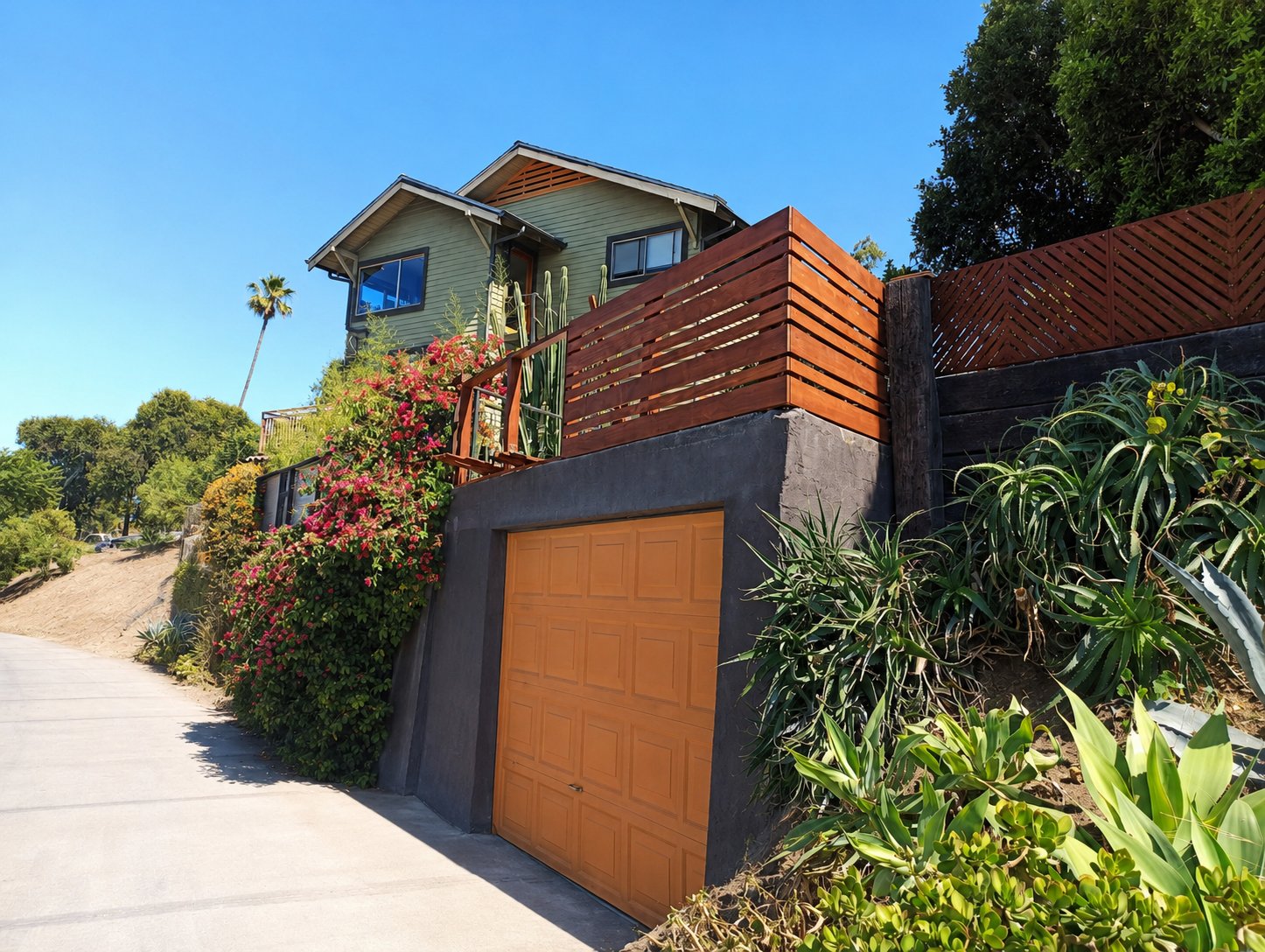
Hillside lots in Los Angeles always involve a retaining wall — the slope holds back, the wall holds it back, and whatever you build on top of that wall is the only thing the street sees at eye level. This LA property already had a solid concrete retaining wall along the driveway, with an integrated vintage wood garage door, but nothing on top — just a sharp drop into the upper yard. We built a modern horizontal cedar plank fence on top of the existing wall: warm honey stained western red cedar laid wide with consistent vent gaps, sitting on concealed metal posts. The wall + fence now read as one elevation from the street.
The brief
The owners wanted privacy in the upper yard from the driveway and the street below, without giving up the view from the top of the lot. They also wanted to keep the original wood garage door — it is an architectural feature of the building and replacing it was not on the table. The fence had to live on top of an existing concrete retaining wall, read as part of that wall (not as a separate add-on), and be sized so it would hide a standing adult from the street while still letting hillside breeze and light through.
The build
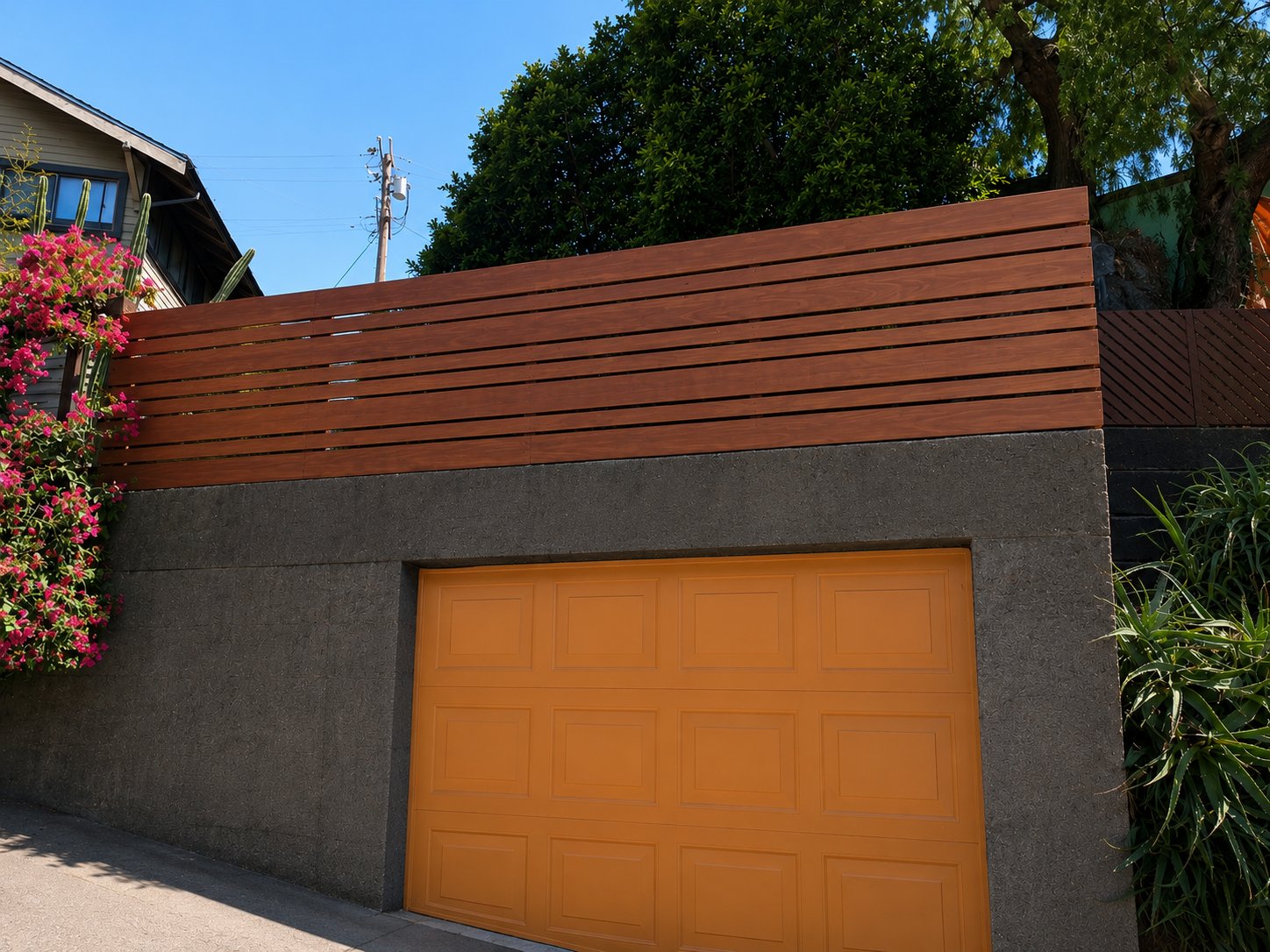
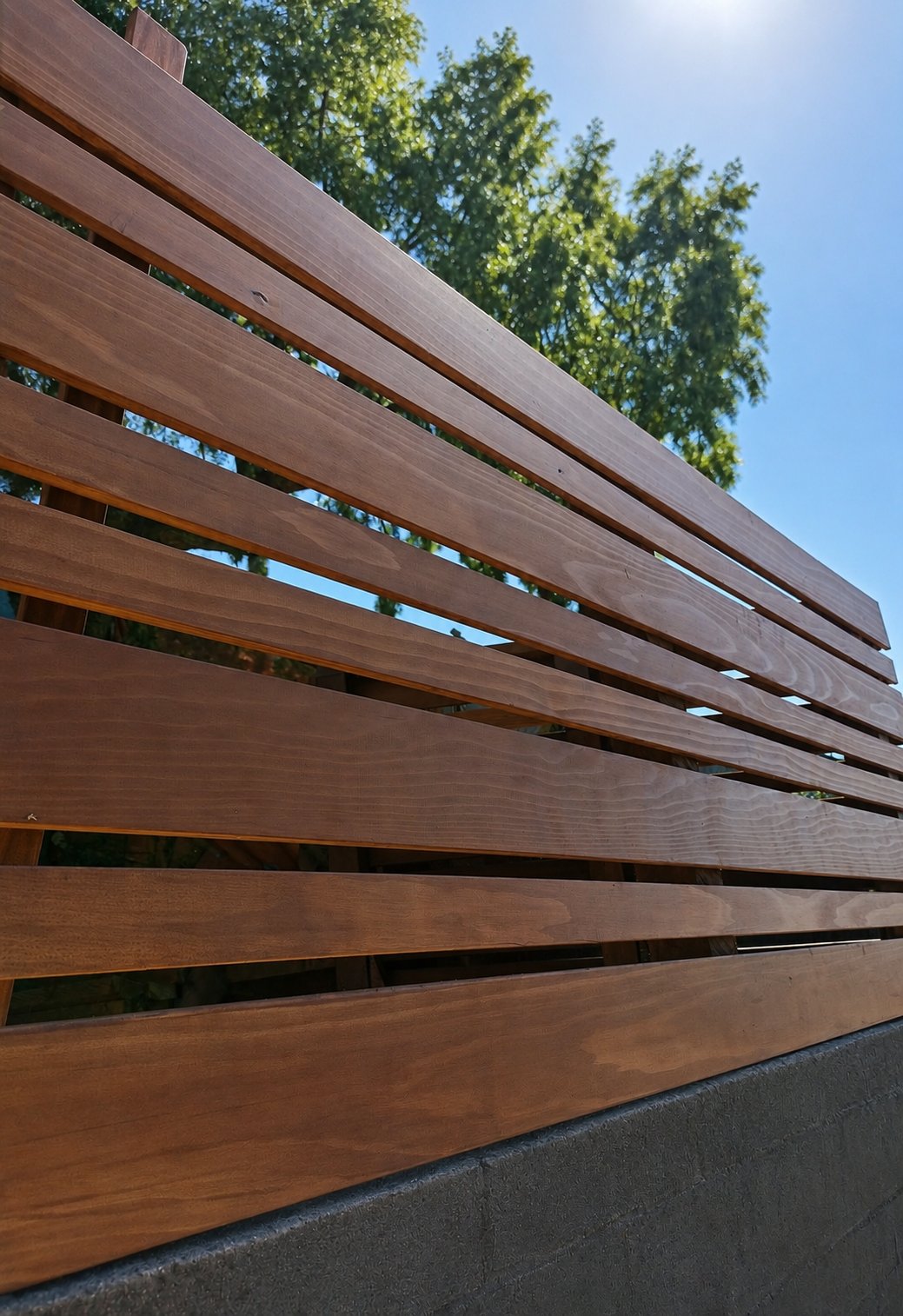
Support posts: galvanized steel posts mounted through the top of the existing retaining wall with structural epoxy and through-bolts, set plumb regardless of how the wall behaves. The posts disappear behind the cedar; what the eye reads is just the wood. Cladding: full-length western red cedar planks, wider than typical slats — about 1×6 nominal — laid horizontally with intentional gaps between boards for ventilation and a softer feel than a solid privacy fence. Finish: warm honey penetrating oil stain, hand-applied, two coats with light sanding between. The stain was matched to the existing wood garage door so the whole street face reads as one material.
Working with the existing wall
The retaining wall was solid but it had its own finish — parged dark gray concrete. We did not paint it, we did not skin it, we did not pretend it was not there. The cedar starts cleanly at the top edge of the wall and runs continuously across the property line. The contrast between the dark concrete and the warm cedar reads as an intentional two-material composition; the alternative (matching the wall to the cedar or vice versa) would have ended up either looking cheaper or fighting the architecture.
Wider planks vs. slats
This is the choice people ask about most. We use thinner slat patterns (we recently did one for a multi-unit property nearby) for tighter privacy and a more rhythm-heavy modern read. Wider planks like these read more relaxed — the eye registers the texture of the cedar as the main story instead of the geometric pattern. On a hillside lot where the cedar is read across a wider distance (from cars driving past, from the property across the street), wider planks win on first impression. Slats work better on close-up applications like a back patio or a multi-unit corridor.
The upper yard side
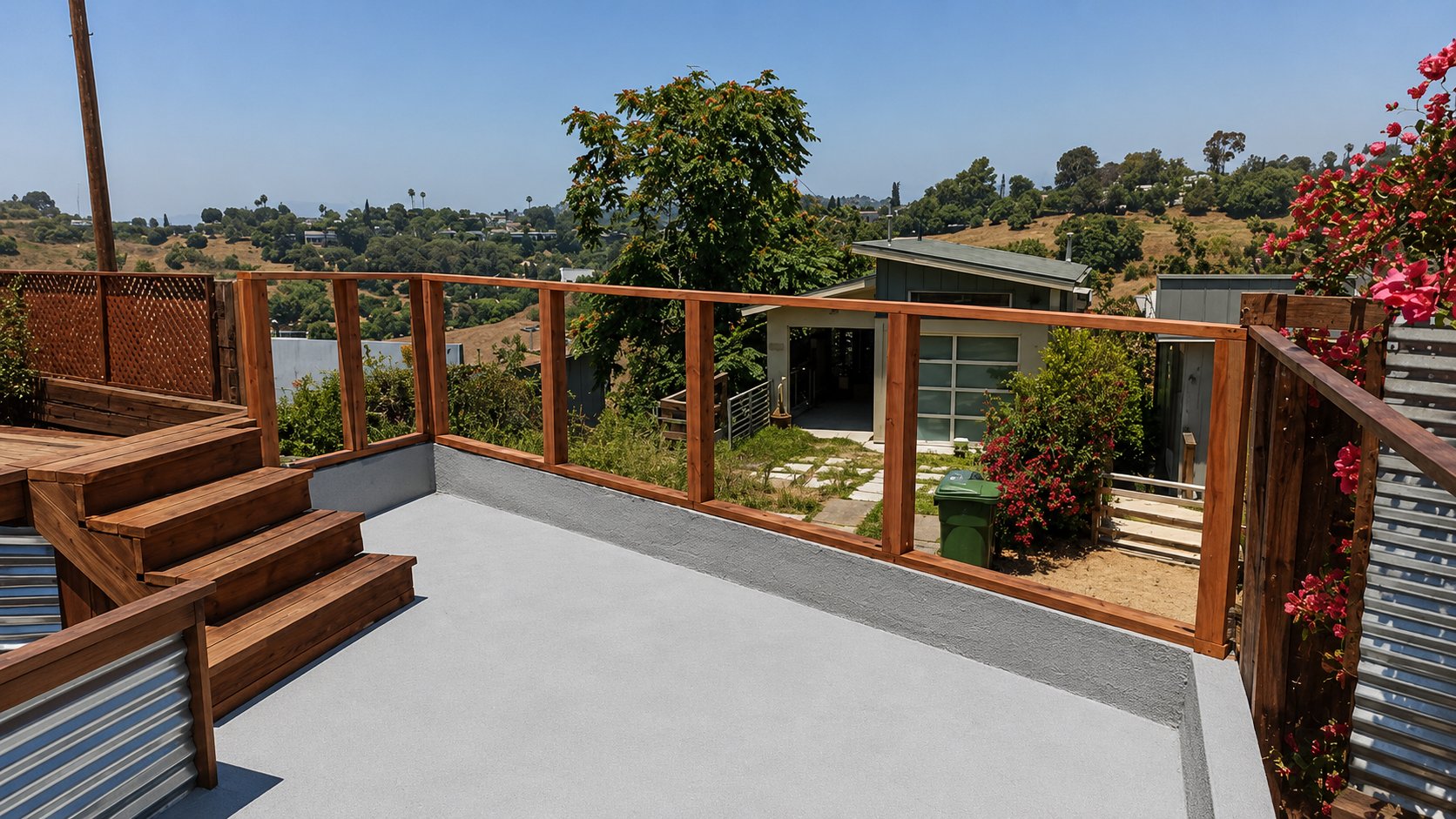
From the inside, the cedar reads as a clean horizontal line against the upper-yard concrete and decking, with hillside views and the canyon beyond. The deck space behind the fence sits at the height the owners actually use it — high enough to lean against the cap and look out, low enough that there is no climb-over concern with kids and dogs. We sized the fence height to the inside use case first, then made sure it cleared the street-side privacy requirement.
Why cedar holds up on a hillside lot
Three reasons we keep specifying western red cedar on LA hillside projects:
Sun exposure is the biggest enemy. Hillside lots get hit from more angles than flat lots. Cedar handles UV better than pine or fir, and stained cedar holds the warm color for years before silvering.
Wind movement is constant. The gaps between planks let air through; a solid privacy fence on a hillside acts like a sail and stresses the posts. Real engineering of the gap-to-plank ratio matters here.
Stain matches the existing wood elements. Most LA hillside homes have at least one original wood feature — eaves, soffit, garage door, deck. Cedar takes any of the standard exterior stain tones, so we can match the new fence to what is already there.
Care and longevity
Stained cedar on a sun-exposed hillside wants a re-coat every 3-4 years. No stripping — light sand, re-apply the same penetrating oil. The galvanized posts are essentially zero-maintenance and live behind the cedar so they do not show wear. Expected service life of the system: 20-plus years; if a single plank ever gets damaged we swap it without disturbing the rest of the run.
Thinking about a hillside fence project?
If you have a hillside lot in LA with an existing retaining wall, a difficult slope, or a property edge that wants privacy without giving up the view, modern cedar on a concealed steel post system is usually the right answer. We design and build to your geometry, work around existing features you want to keep (like a vintage garage door, a wall, a stair), and finish to a palette that matches the rest of the house. Send a few photos and the layout; we will come out the same day for a free on-site estimate.
Related guides: Modern Cedar Slat Privacy Fence in Los Angeles (multi-unit) · Modern Horizontal Wood Fence in Los Angeles · Fence Installation in Los Angeles (service overview) · Fence, Railing & Gate Photo Gallery
2 Responses