
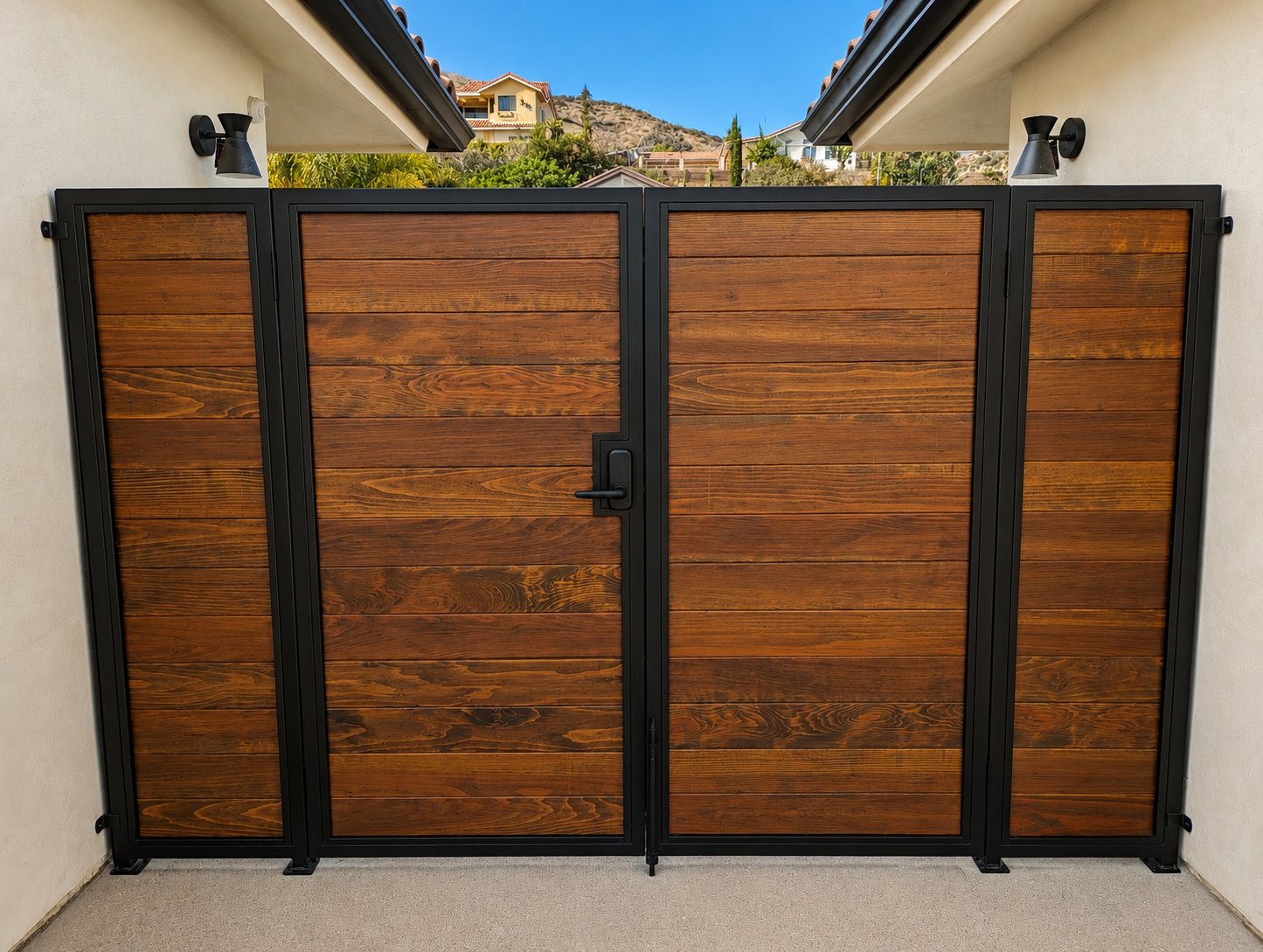
This hillside Los Angeles home wanted one coordinated design language across every metal-and-wood detail on the property — the main entry, the side access, and the utility/HVAC corners that would otherwise show as visual clutter. We built a full set: a double-leaf main gate with flanking fixed panels, a tall single-leaf side gate, and matching steel-and-wood privacy screens hiding the AC condenser and the exterior utility access. Black welded steel frames, deep stained horizontal wood infill, modern hardware. Every piece reads as part of one architectural decision.
The brief
A modern-Spanish hillside home with a wide entry court, terracotta tile roof, and white stucco walls. The owners wanted a strong, intentional entrance — not a typical iron gate, not a typical wood gate — and they wanted that same vocabulary repeated around the AC unit on the side of the house, the utility access door, and the side-yard pedestrian gate. Goal: every black-metal-and-wood object on the property obviously belongs to the same family.
The system
Frame: 2-inch square welded structural steel, ground smooth, powder-coated matte black for the indoor-grade flatness and the long-term UV resistance. Frame depth is consistent across every piece — gate, panel, screen — so the eye reads the same proportion everywhere on the property. Infill: full-length tongue-and-groove kiln-dried hardwood, laid horizontally inside the frame, finished in a deep walnut penetrating oil stain that pulls the natural grain forward without making the wood look painted. Hardware: black matte modern handles, hidden hinges on the panels, heavy-duty self-closing hinges on the swing gates.
The main double-leaf gate
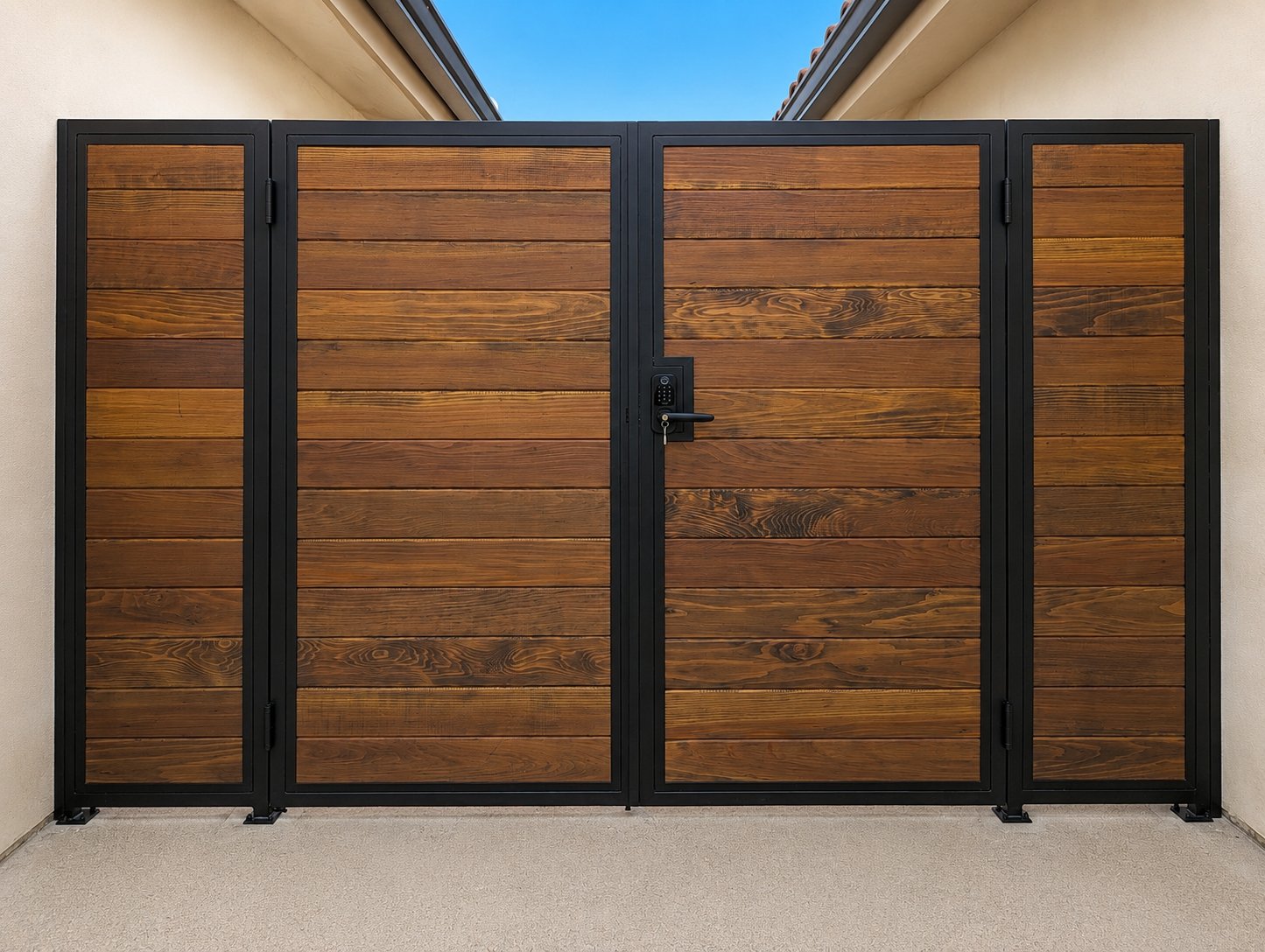
Two leaves open from the center, with a fixed panel on each side that matches the gate exactly. The fixed panels act as the wing of the entry — they extend the visual width of the gate without adding moving parts, which means less hardware to age and more presence at the street view. The handle is a single black matte drawer-pull-style fitting centered at hand height, mirrored on both leaves. Frame proportions were tuned so the horizontal wood-board lines flow across the seam between gate and fixed panel; from ten feet back it reads as one continuous wood wall with a hairline center seam where the gate opens.
The side access gate
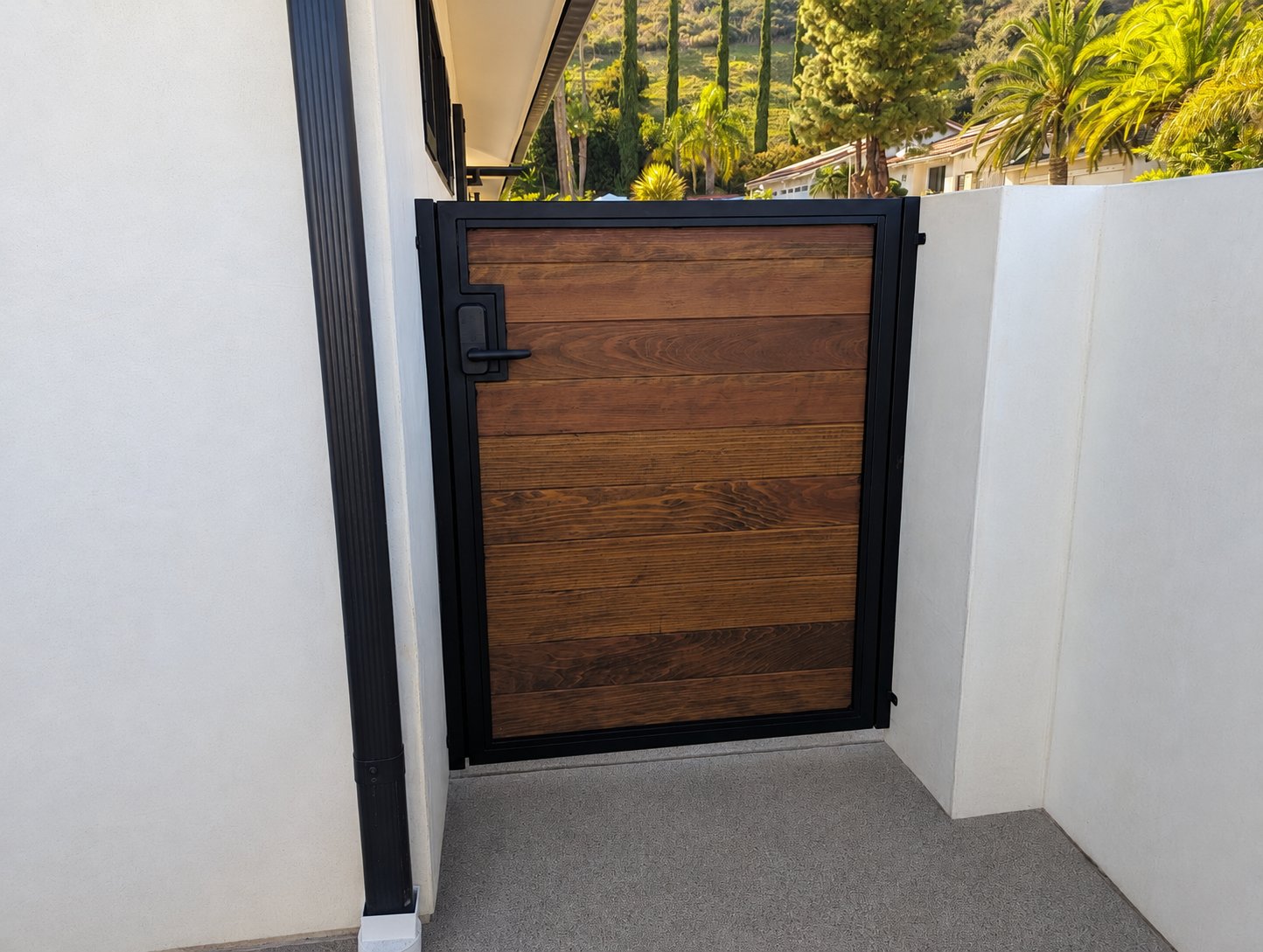
Tall single-leaf gate in the side path between the main house and the wing. Same frame, same infill, just narrower — set between two slim steel posts mounted to the stucco. Handle in the same family as the main gate. This is the everyday gate the family actually uses — proper self-closing hinges, full-height latch hardware that mounts cleanly into the steel frame.
The AC privacy screen
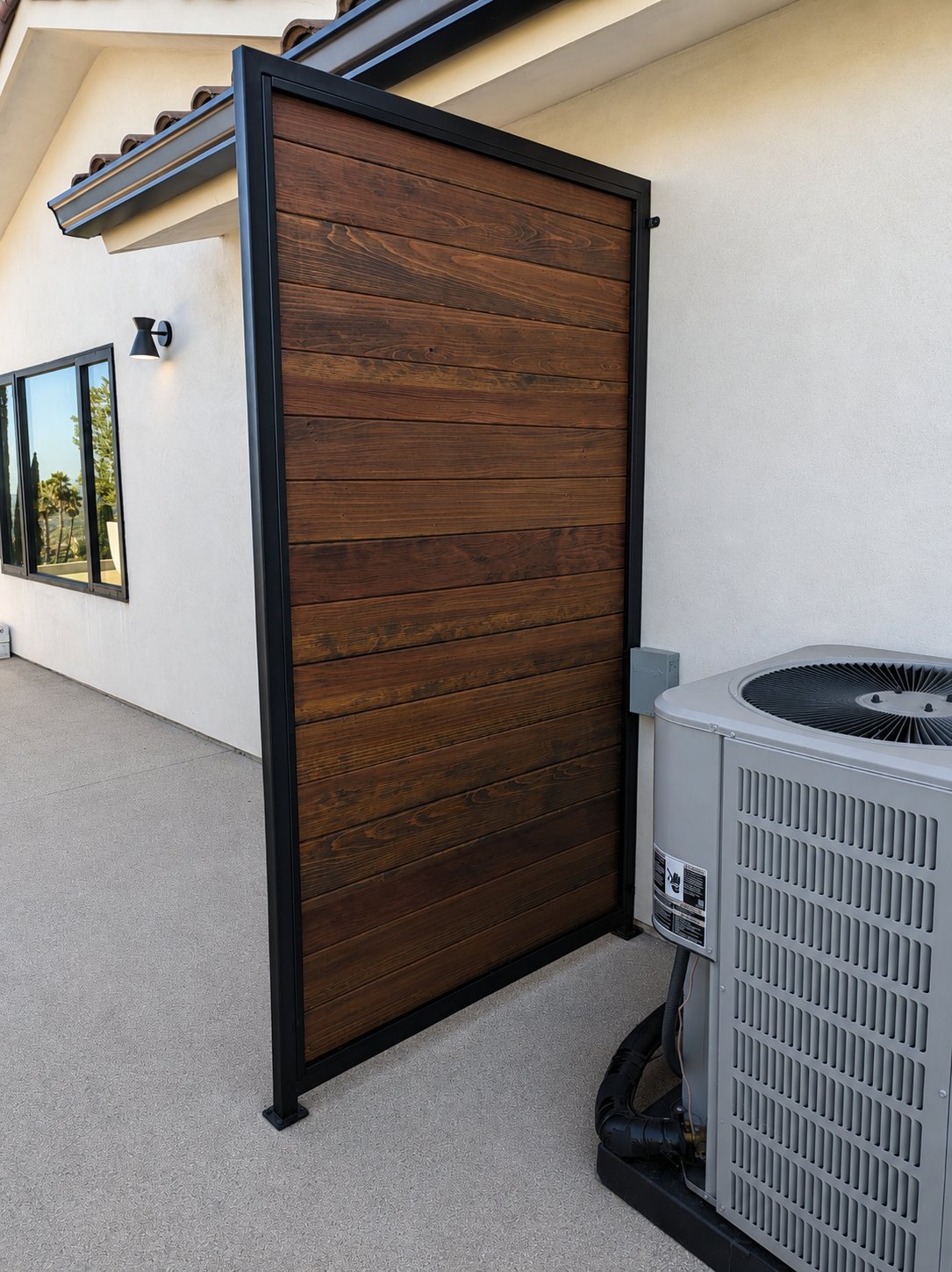
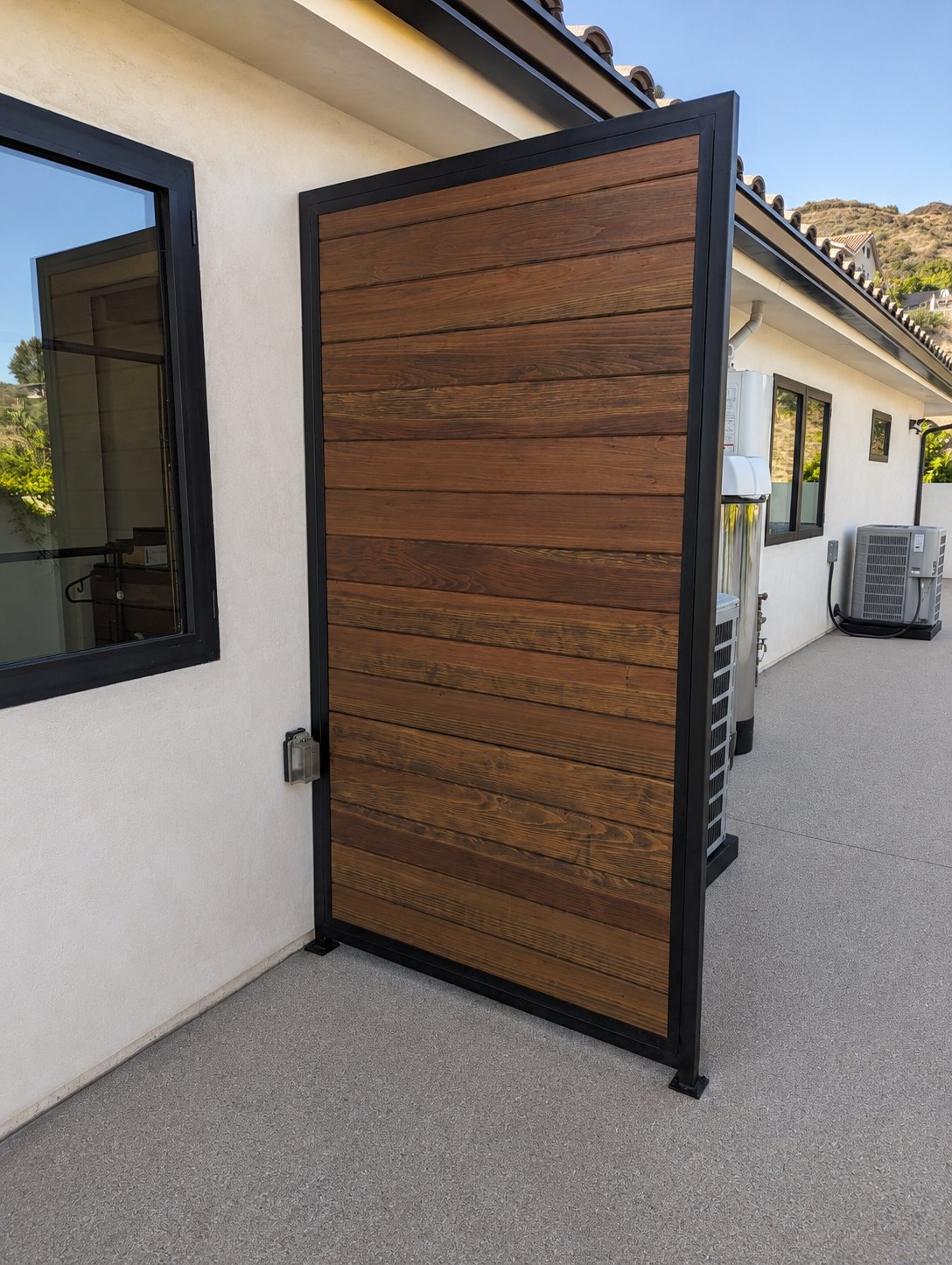
The HVAC condenser sat in plain view from the side patio and from inside the kitchen window. We built a freestanding steel-and-wood privacy panel in front of it — same frame, same infill, set on its own base plates so it ventilates the back side of the panel and the AC unit can still breathe. Visually the AC stops existing; functionally the unit still runs at full efficiency because we did not enclose it, only screened it.
The utility screen
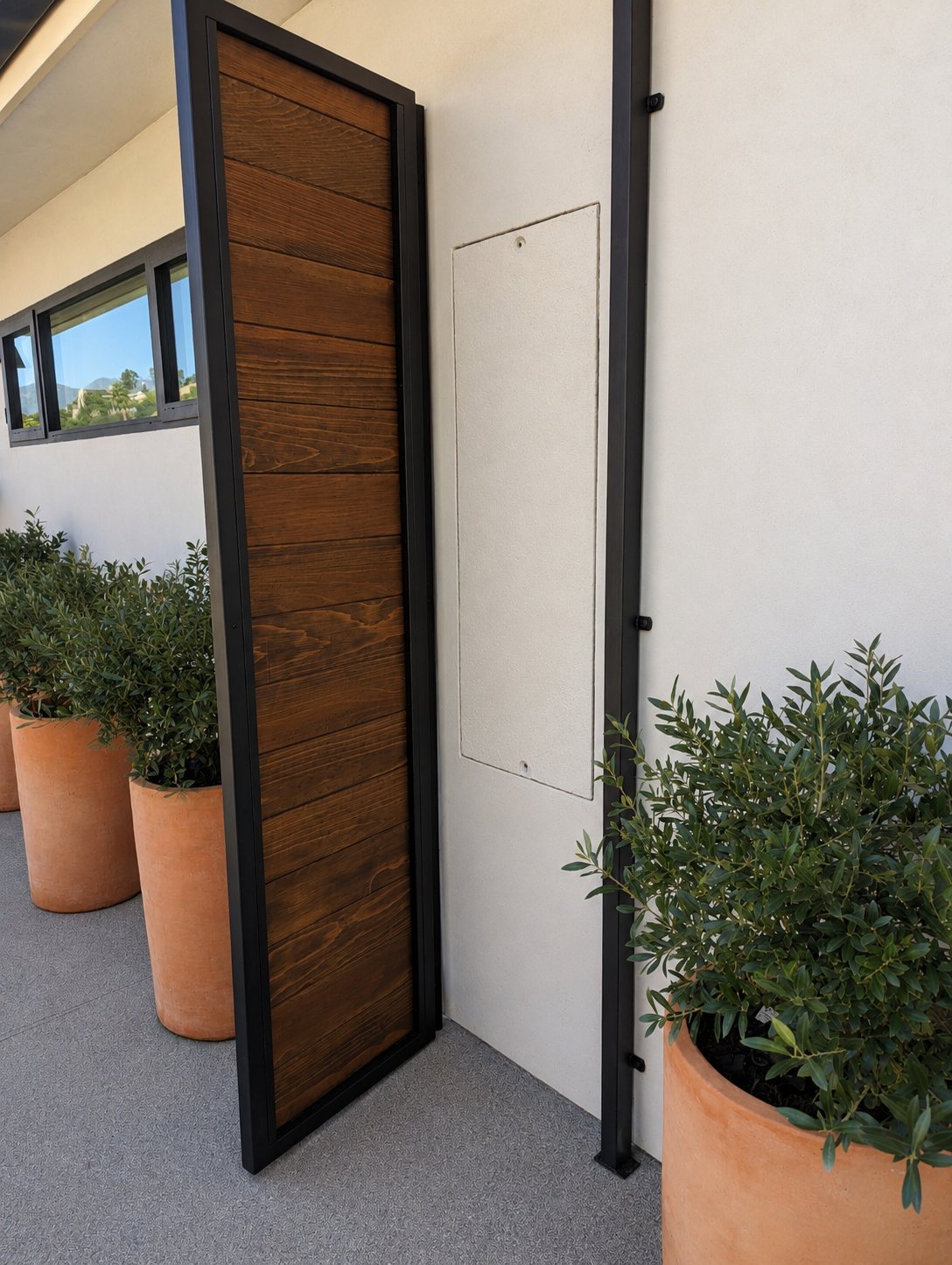
A separate matching panel hides the exterior access door to the home’s utility area — same frame, same wood, same proportions as the AC screen. Together with the terracotta planters and the olive saplings, the side patio reads as a designed walking corridor instead of a service alley.
Why steel frame + hardwood infill on a premium property
Three reasons we kept specifying this combination for this house:
The frame is what makes the long-span lines stay straight. A pure wood gate or panel at this height will twist and bow within a season. Welded steel stays square forever, and the wood inside it can move slightly without anything visible happening on the outside.
Hardwood reads as a single material. Cedar reads as boards. Hardwood with this stain reads as one warm panel. On a property where the gates and screens are doing architectural work, you want the wood to be a surface, not a pattern of slats.
Repeatability across the property. Once we tuned the frame proportions, the infill spacing, and the stain, we could replicate the same system across the main gate, the side gate, and the screens. The result is a property where every black-and-wood element obviously belongs together.
Materials and finish
Frame: cold-rolled steel tube, fully welded corners ground smooth, powder-coated matte black. Infill: kiln-dried hardwood T&G boards finished with a penetrating oil stain in deep walnut. Hardware: matte black modern handles and hidden hinges, heavy-duty self-closing hinges on the operating gates. Posts: structural steel anchored through the stucco into the concrete pad and the home’s structural framing where applicable.
Care and longevity
Penetrating oil stain on hardwood holds up for years in LA sun; we recommend a light re-coat every 4–5 years to keep the depth of color, no stripping required. The black powder coat is essentially zero-maintenance on the steel. Hinge bearings on the swing gates are good for 20+ years of normal residential use. Expected service life of the complete system: 25-plus years.
Thinking about a coordinated gate + screen project?
If you have a premium home where the gates, the side access, and the utility screens currently look like three accidents instead of one design move, building the whole set as one system is the right answer. We engineer the frame proportions and finishes so every element on the property reads as part of the same architecture, work around existing features (HVAC, access doors, planters), and finish to your exact palette. Send a few photos and the layout; we will come out the same day for a free on-site estimate.
Related guides: Steel-Frame Wood Gate Built Not to Sag · Custom Wood Gate Installation in Los Angeles · Gate Installation in Los Angeles (service overview) · Fence, Railing & Gate Photo Gallery