
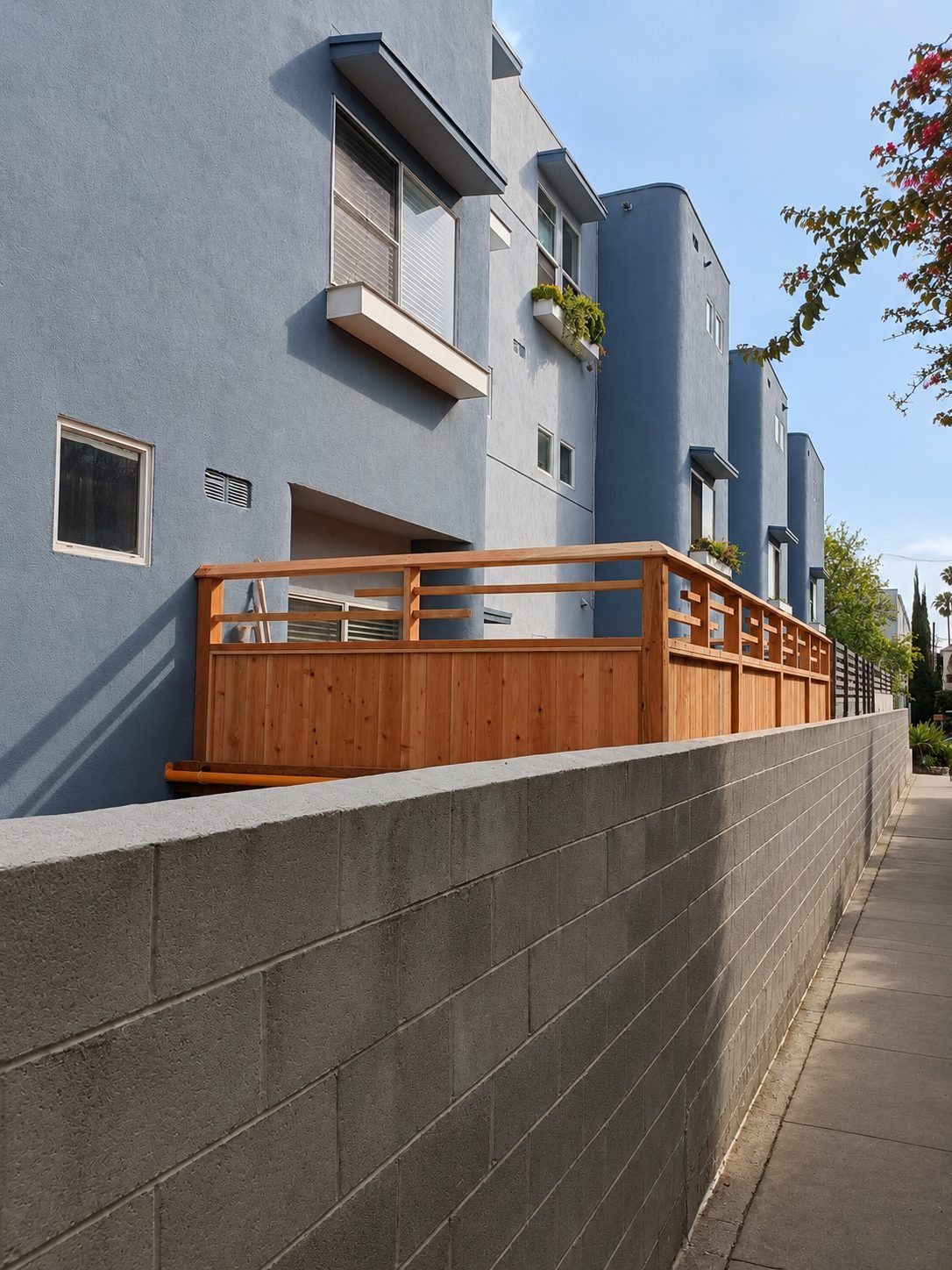
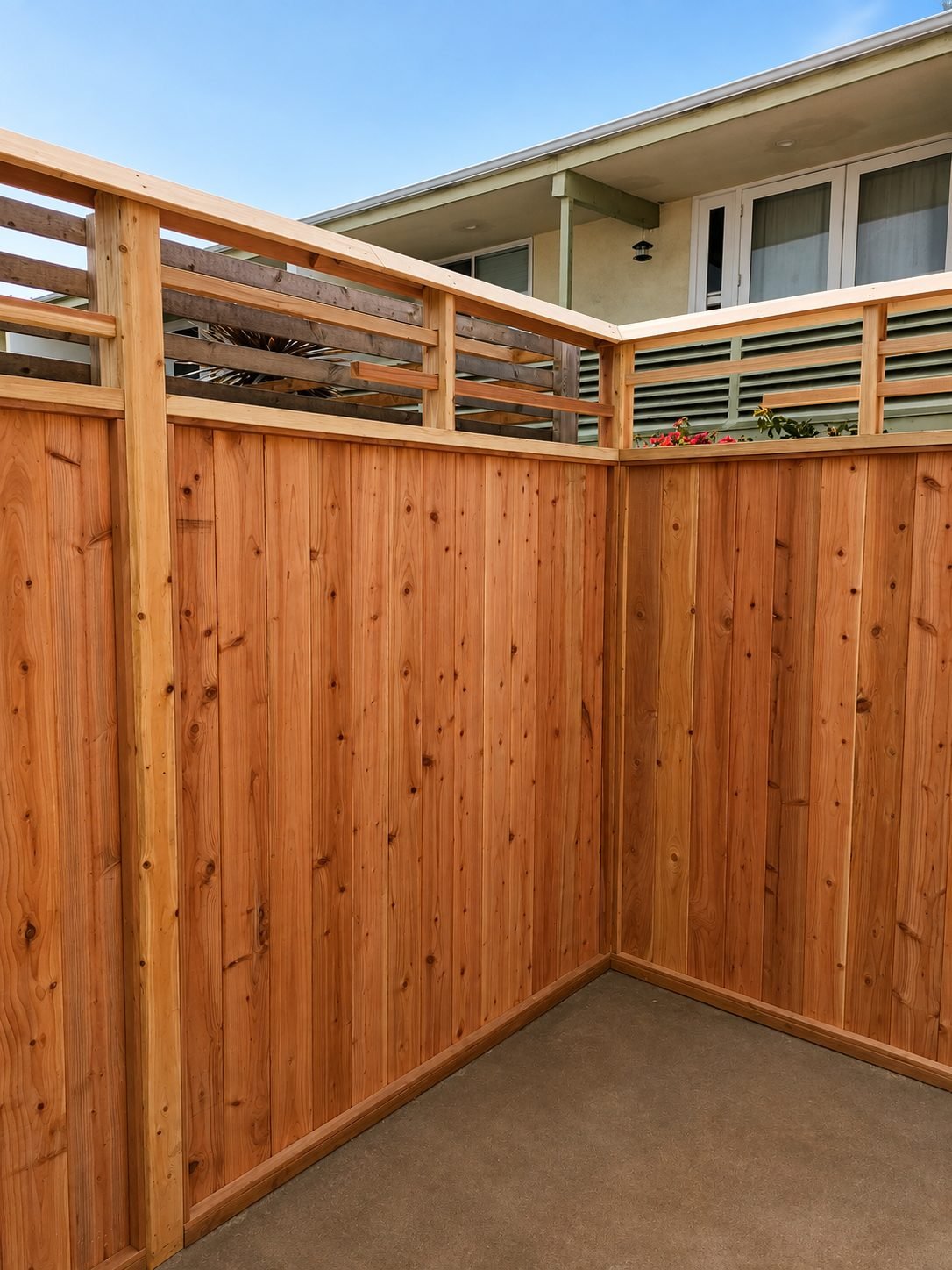
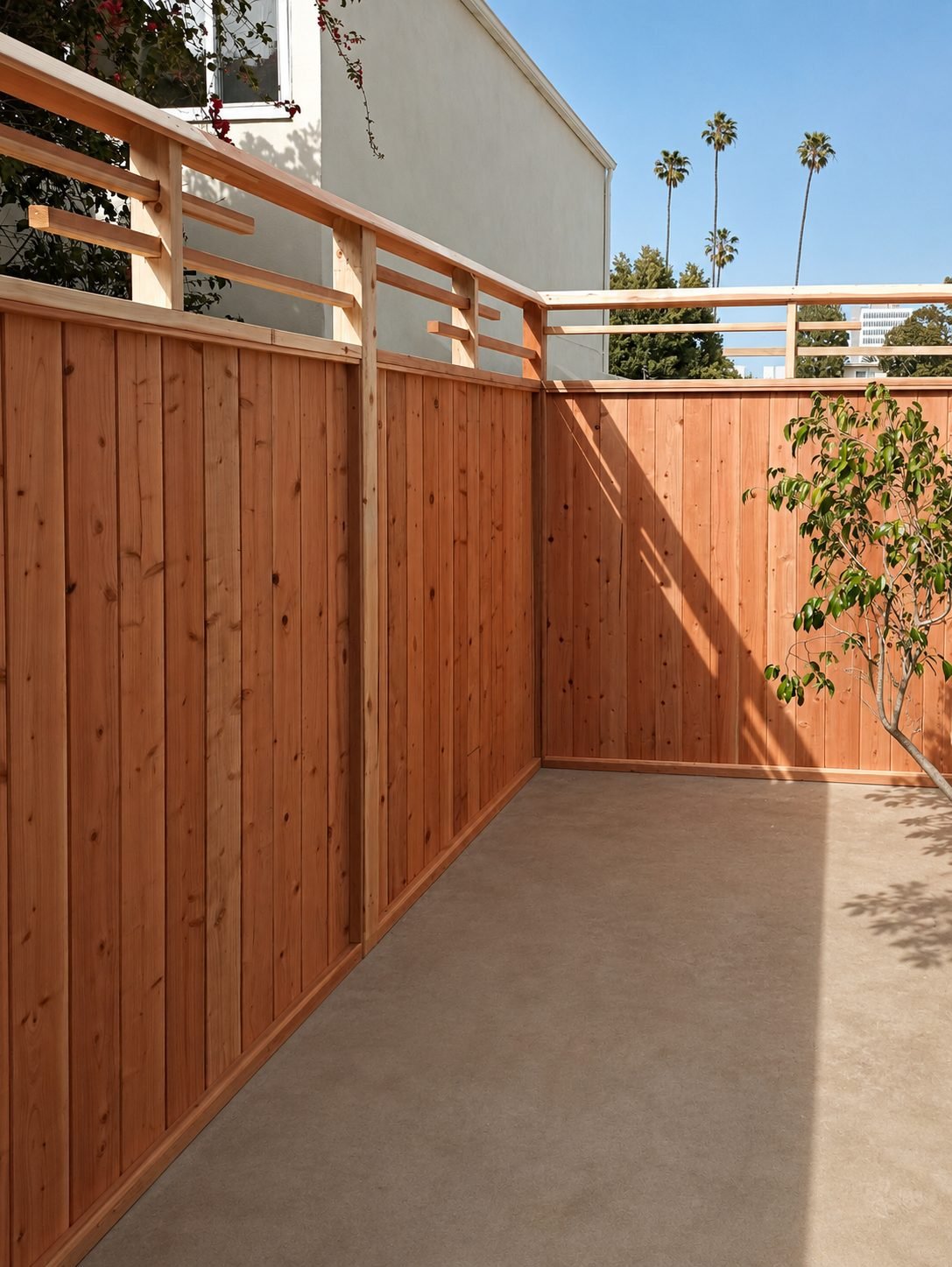
A natural redwood privacy fence installed on top of an existing CMU (concrete block) wall for a modernist townhouse complex in Santa Monica. Two-tier design — solid tongue-and-groove California redwood panels below for full privacy, horizontal open-slat frame above for light, ventilation, and architectural line. All natural redwood color, no stain, no paint — the material is the finish. Warm, honest wood against the cool blue stucco of the building, a Santa Monica-specific pairing that ages beautifully in coastal light.
This is not a stock fence panel dropped on top of a wall. Every board is California heart redwood, cut and fit on site, mounted on a custom cedar sub-frame that ties into the existing block wall without compromising it. The result is a fence that reads as an intentional extension of the architecture rather than a privacy add-on.
Project Overview
The scope on this Santa Monica install:
- Existing CMU (concrete masonry unit) block wall along the property line — retained
- Custom sub-frame mounted to the top course of the CMU wall to receive the redwood fence
- Two-tier redwood fence design — solid privacy panel below, open horizontal slat frame above
- Full-house-length run along the sidewalk-facing side of the property
- Matching redwood-slat garage gate below for the parking bay entrance
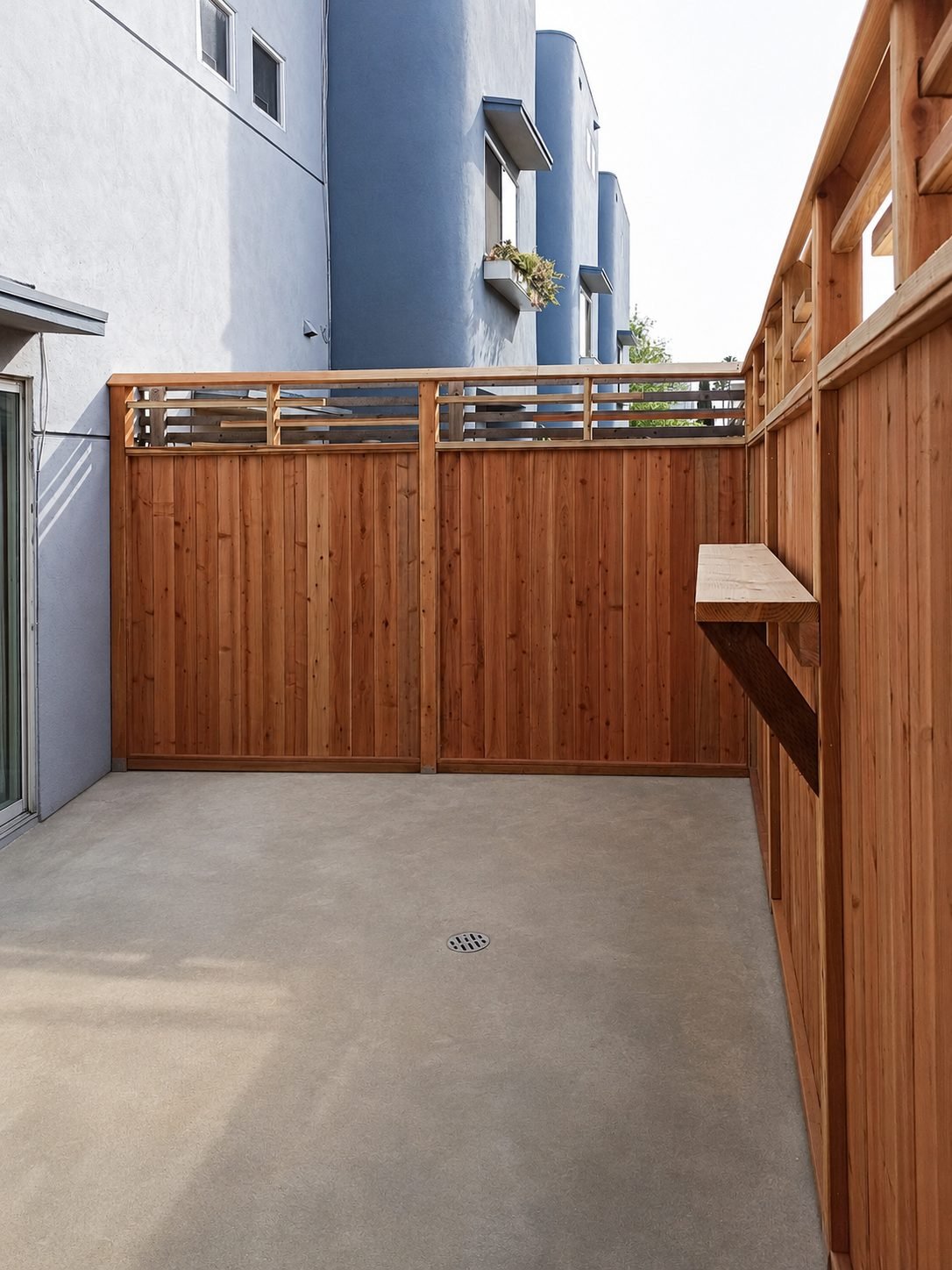
- Built-in redwood floating shelf on the courtyard-facing side, tying into the fence structure
- Natural redwood finish — no stain, no paint, no sealer
Why Redwood — And Why Natural (No Stain)
The owner walked us through the constraints: coastal Santa Monica air (salt exposure, marine humidity), full-day sun on the sidewalk-facing side, low-maintenance expectation, modernist design language for the building, and a preference for wood over vinyl or metal. Redwood was the right choice for all of those.
- California heart redwood is naturally weather-resistant. The heartwood has natural tannins that resist rot, insects, and fungal growth without any chemical treatment. It’s the specific reason we still see 60-year-old redwood decks and fences in this state.
- Natural color reads warm without stain. Fresh-milled California redwood has a warm cinnamon-terracotta tone that pairs specifically well with cool paint colors — blues, grays, off-whites. On this blue stucco building, the redwood provides visual warmth without competing.
- It ages into a silver-gray patina. Redwood in coastal LA sun turns to a soft silver-gray over 2–3 years. Some owners re-oil to preserve the warm tone; others let it silver naturally. Both look intentional; there’s no “chalky failure” phase like painted wood.
- Zero-maintenance option. If you accept the silver patina, redwood needs essentially no maintenance beyond a spring rinse. If you want to preserve the warm tone, one coat of clear oil every 2–3 years is the whole maintenance program.
- Modernist compatibility. Warm natural wood against blue/gray stucco is one of the strongest architectural pairings in modern Californian design. Painted wood or stained wood breaks that language.
Installing Wood on Top of a CMU Wall — The Structural Detail
Mounting a wood fence on top of an existing concrete block wall is a specific installation challenge. Cheap installers surface-screw the fence to the block face. That fails: within one wet season, water finds the fasteners, block cracks around the anchors, and the whole fence starts leaning off the wall.
The correct method — and what we did on this project:
- Continuous cap plate. A pressure-treated 2×6 or 2×8 mounted flush to the top of the block wall using epoxy-set anchors, sealed with construction adhesive underneath. This becomes the platform the fence framework attaches to.
- Wood posts through the cap plate, not surface-mounted. The posts pass down through the cap plate and lock into the top of the block wall — either into partially-filled block cells with epoxy, or into steel post anchors mortared into the block top course. This gives the posts real lateral resistance.
- Flashing detail. Metal flashing under the cap plate and over the block wall top edge, so no water penetrates the wall/wood joint. Coastal Santa Monica air makes this non-optional.
- Sealed penetrations. Every anchor bolt hole in the block wall is epoxy-sealed. No open holes for water to enter the block cells.
- Stainless or hot-dipped galvanized fasteners throughout. Standard fasteners will bleed rust into the redwood within a year of coastal air exposure. All hardware on this install is stainless.
The Two-Tier Design — Solid Below, Open Above
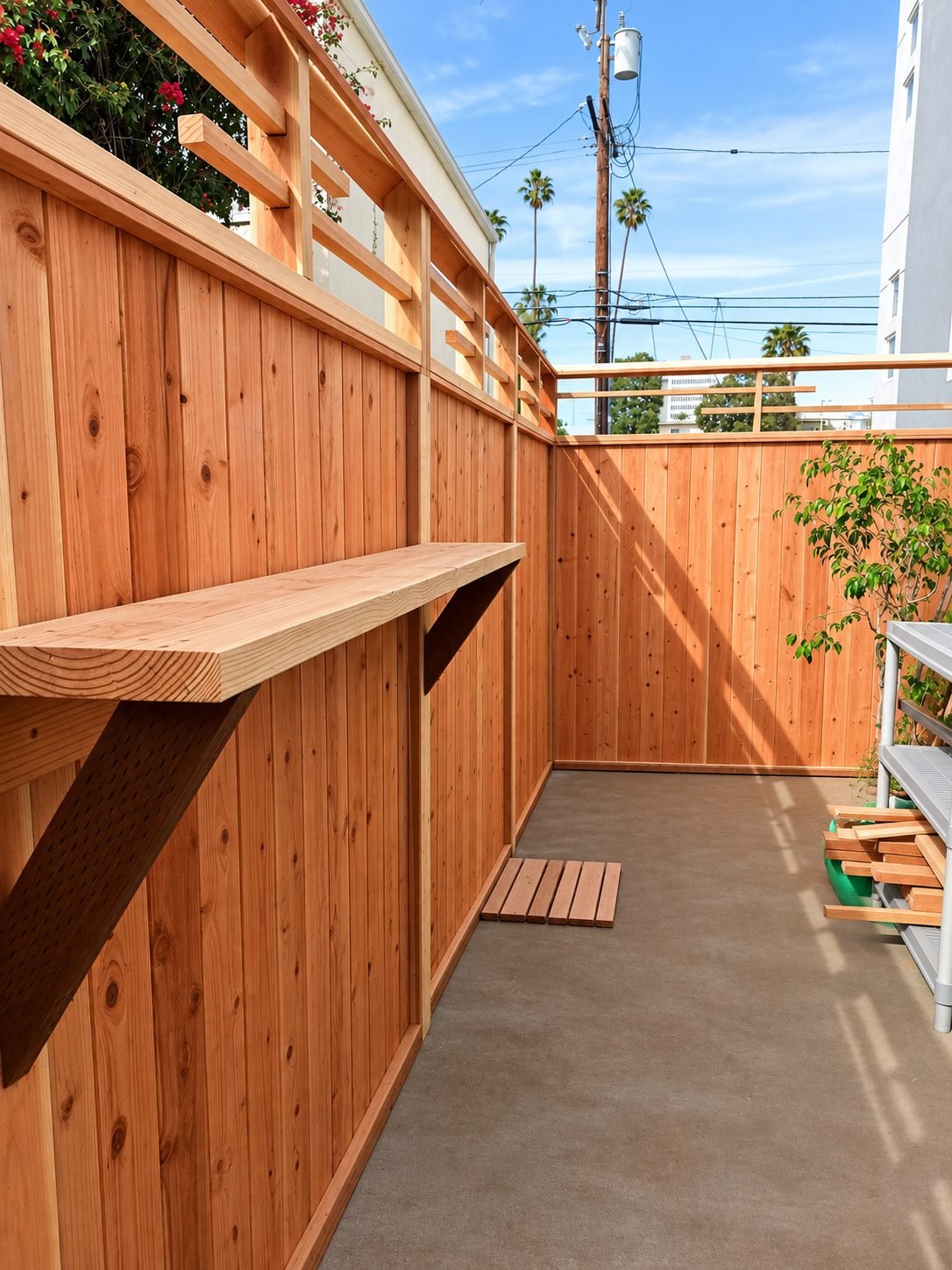
The specific design choice on this fence is a two-tier field: solid tongue-and-groove redwood boards for the lower ~2/3, and horizontal open-slat frame for the upper ~1/3.
Why this configuration:
- Privacy where you need it, light where you don’t. At standing eye level (from the sidewalk side), the solid lower panel blocks direct sightlines into the property. Above that, the open slat top lets afternoon light into the courtyard behind the wall rather than casting a dead shadow.
- Ventilation. A solid 8-foot wood wall traps air. The open top lets marine breezes flow through, which matters more on the coast than inland — trapped moist air against wood accelerates aging.
- Architectural line. The slat top creates a horizontal detail band at the top of the fence that visually caps the composition. Without it, the fence reads as a flat wall. With it, the fence reads as a designed element.
- Height compliance. Santa Monica has strict fence height rules along street-facing lots. The two-tier design achieves visual mass at lower height and lets the top section — which counts as different type of screening — extend within code.
- Softens the block wall. The CMU wall below is a hard, industrial element. The two-tier redwood above softens and humanizes it while adding real privacy.
Matching Redwood Slat Garage Gate
The garage entrance below the fence needed a gate that matched the fence language without repeating it exactly. We built a vertical redwood slat gate — narrower gaps between slats, providing partial visual screening but full drivability access.
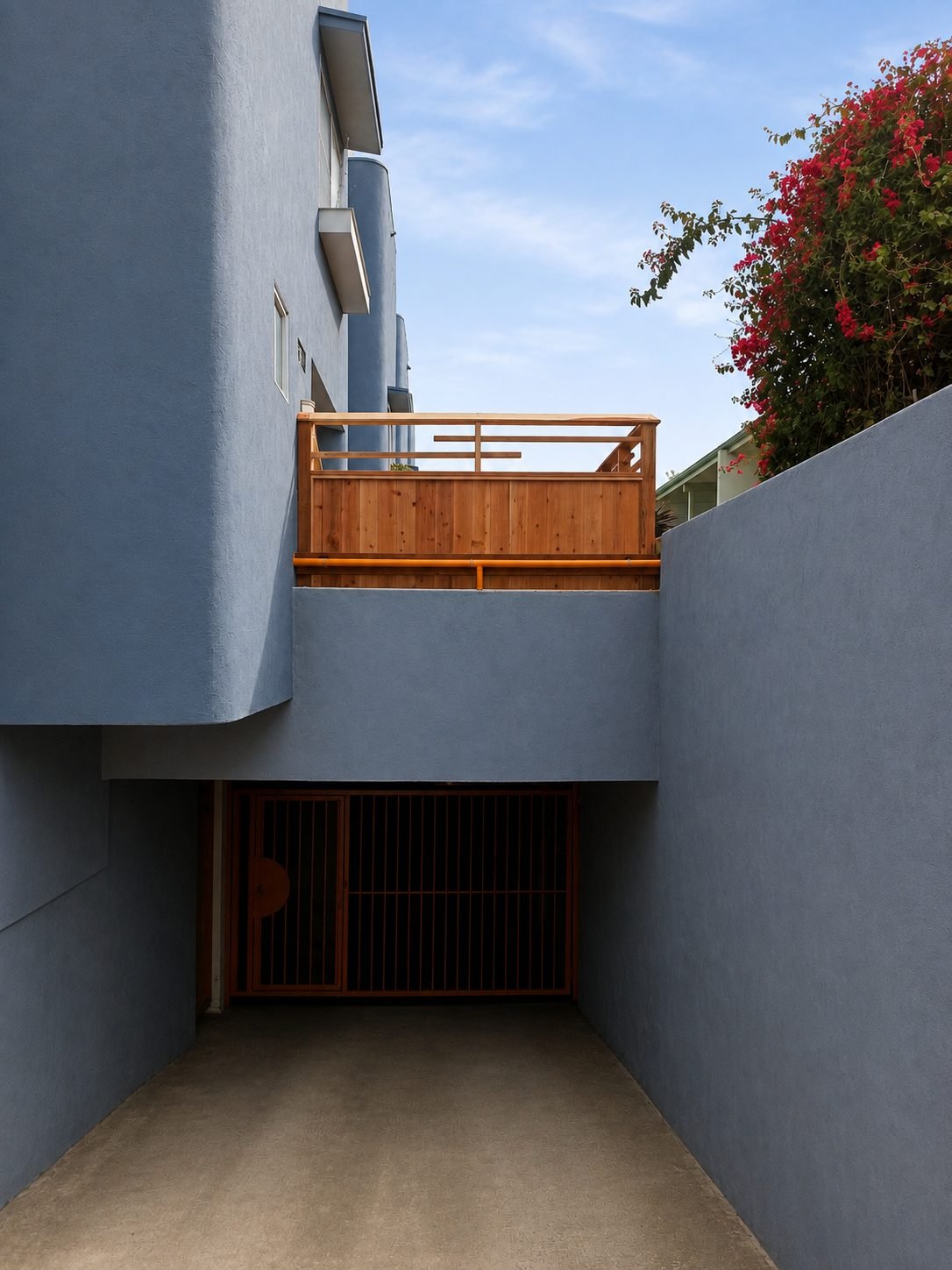
Vertical slats for the gate, horizontal slats for the fence top — the same material and finish but different orientation. That’s an intentional design distinction — it reads as related but not identical, so the eye doesn’t tire of a repeated pattern.
Gate construction details:
- Steel-frame core with redwood slat cladding — necessary for a wide garage-access gate to resist sagging
- Heavy-duty hidden hinges — no visible hardware on the front face
- Auto-return spring mechanism — gate re-latches on its own
- Concealed release for pedestrian access from the courtyard side
The Built-In Courtyard Shelf
On the courtyard side of the fence, we integrated a natural-redwood floating shelf that runs along one section of the fence run. Small detail, big functional impact — the courtyard now has a serving surface, a plant stand, or a work-from-outdoors ledge, without an additional freestanding piece cluttering the space.
The shelf is structural to the fence — the fence framework accepts the shelf brackets from the back, so no visible fasteners on the courtyard face. Redwood shelf top ages with the fence, so the whole assembly patinas together.
Coastal Santa Monica Wood — Real Trade-offs
Homeowners near the coast often ask us: is wood the right call given the salt air? Compared to alternatives:
- vs Vinyl: Vinyl is zero-maintenance but reads as vinyl. On a modernist property, vinyl doesn’t have the material honesty of wood — and it can yellow slightly under long-term coastal UV even with UV stabilizers. Wood ages more elegantly.
- vs Metal (steel or aluminum): Metal fences resist salt air but need powder-coating or paint to prevent corrosion, and the coating fails on a 5–8 year cycle. Redwood ages naturally without failure — it just changes tone.
- vs Cedar: Cedar is beautiful but softer, doesn’t hold up as well in coastal salt/UV combination, and needs more maintenance to keep its color. Redwood is the specifically California-native choice.
- vs Ipe or Tropical Hardwoods: Denser, more durable, but massively more expensive and heavier. Redwood is the sweet spot of durability, cost, and appropriate species for California coastal use.
How This Fence Ages
With California heart redwood, no stain, correctly-installed on a CMU wall base, in coastal Santa Monica conditions:
- Year 1: Warm cinnamon-terracotta redwood color. No maintenance needed.
- Years 2–3: Wood starts developing the classic silver-gray patina, most visible on sun-facing sides. Slow, uniform transition — not blotchy.
- Year 5: Full silver-gray patina achieved. Some owners prefer this look and stop here. Others do a light re-oil coat around year 3 to hold the warm tone longer.
- Years 5–15: Silver patina stabilizes. The wood surface hardens with age. Structural integrity remains excellent for 20+ years.
- Year 20: Redwood fences of this construction quality are still in service — coastal air permitting — with only a possible top-cap replacement if desired.
Signs You Want Redwood Instead of Alternative Materials
- Your house has cool-toned exterior (blue, gray, off-white) that would pair with warm natural wood
- You value material honesty — you want the fence to look like what it is, not pretend to be something else
- You’re on the coast and want a material that ages elegantly under salt/UV combination
- You’re okay with a natural silver patina developing (or willing to re-oil every 2–3 years to hold the warm tone)
- You want a fence that reads as an architectural feature, not just a boundary marker
Considering a Redwood Fence in Santa Monica or Coastal LA?
ProHands Home Improvement designs and installs premium redwood privacy fences, natural-finish redwood gates, and custom exterior wood details across Santa Monica, Los Angeles, Glendale, Burbank, Pasadena and the surrounding coastal and inland neighborhoods. California heart redwood, correct structural installation on existing block walls, coastal-appropriate hardware, and finish detailing that lasts.
Contact us for a walk-through and a straight-forward quote — real material grade, real installation method, real long-term result.