
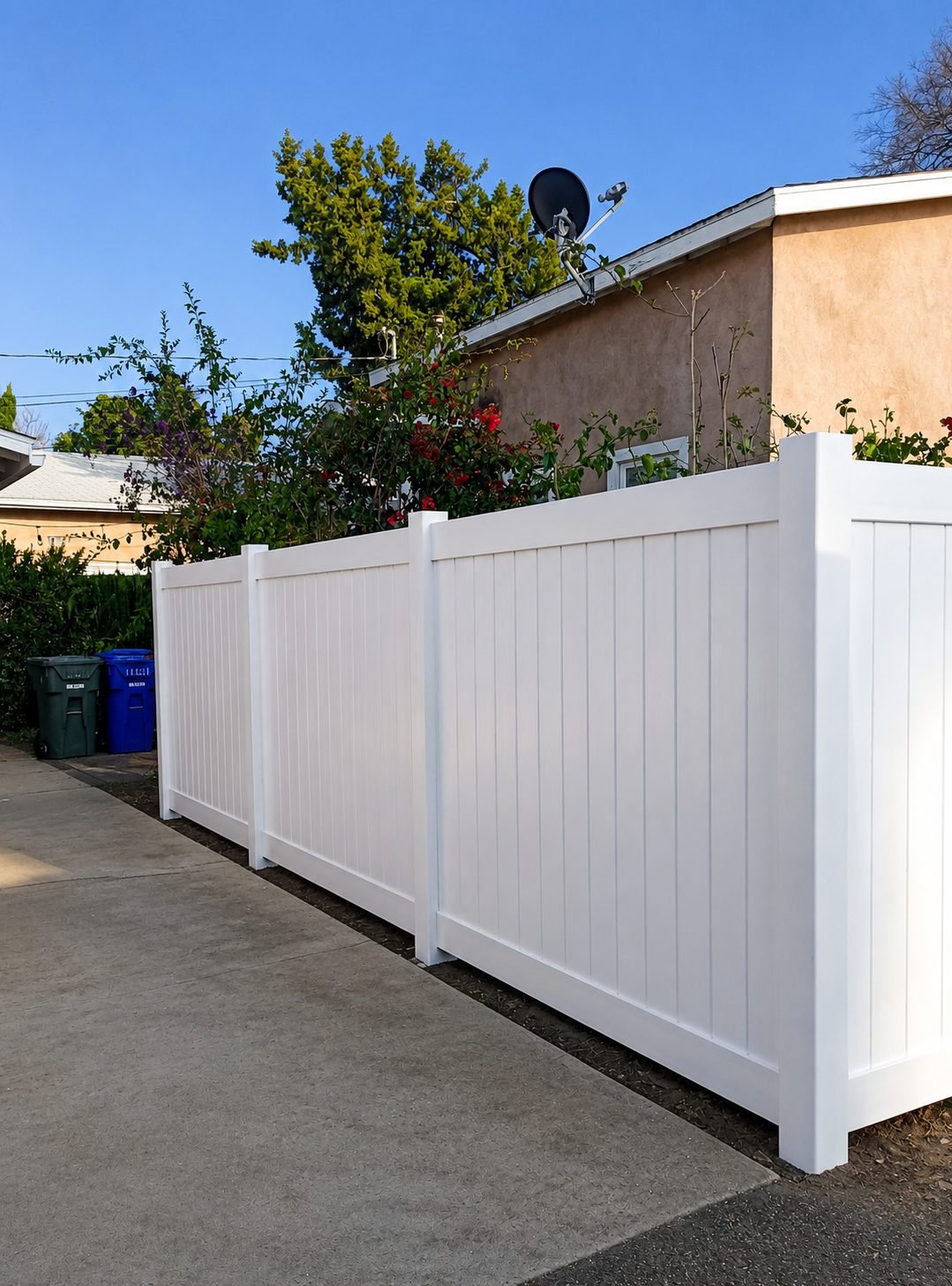
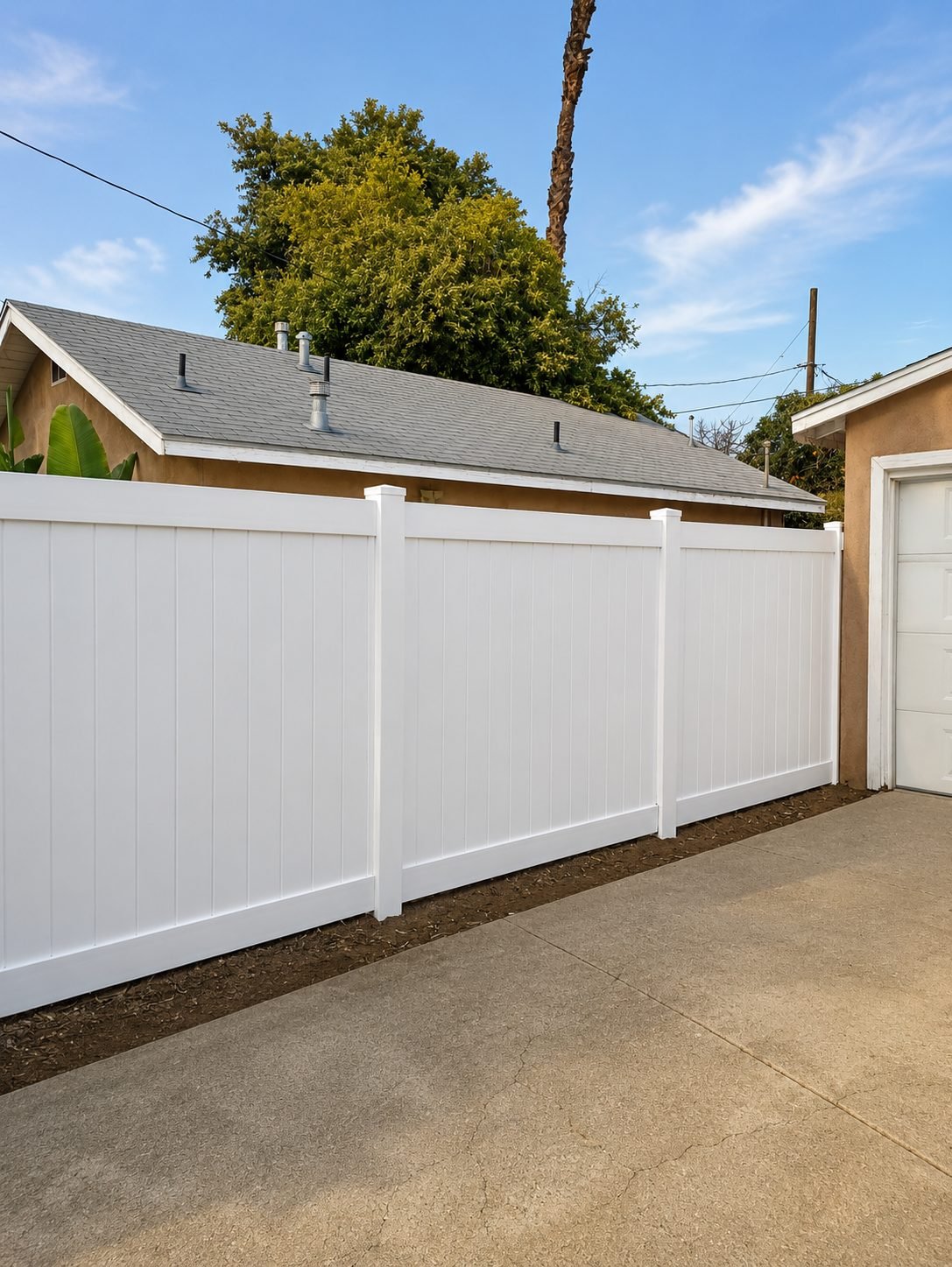
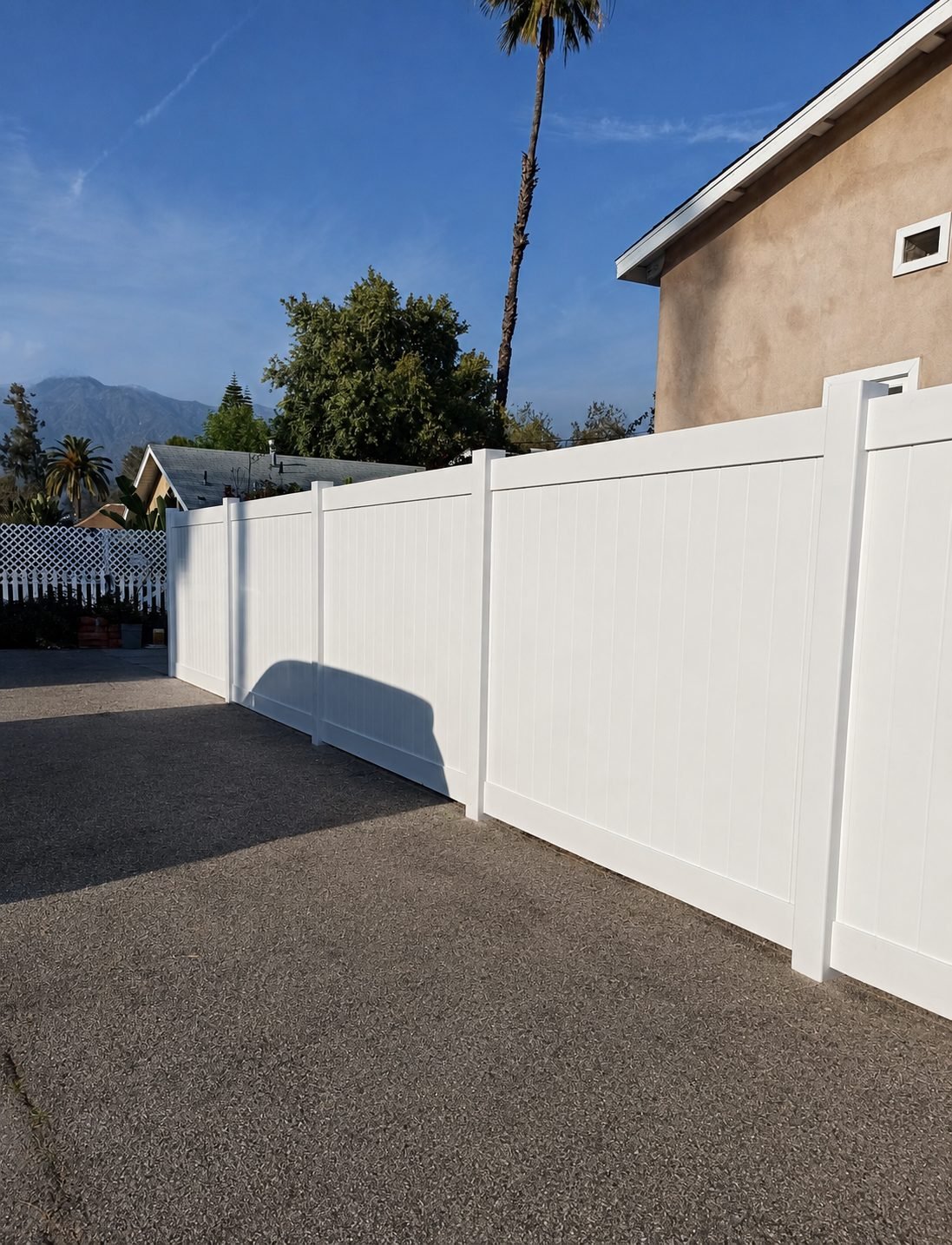
A full-perimeter white vinyl (PVC) privacy fence installation in Los Angeles — new posts set in concrete, solid tongue-and-groove panels, a drive gate and a pedestrian gate, all in bright white vinyl with matte black steel hardware. Clean lines, complete privacy, and zero paint or staining needed for the next twenty years. This is the vinyl fence built right — not the wobbly, out-of-plumb kind neighbors put up in a weekend.
Vinyl fence looks simple. That’s the point of it. What isn’t obvious from the outside is that a vinyl fence lives or dies on the parts you don’t see — the posts, the concrete footings, the way the rails are locked into the posts, and the hardware on the gates. Get those right and the fence stands straight for two decades. Get any of them wrong and the fence starts leaning, sagging at the gates, or popping panels out of the rails within a couple of years.
Project Overview
This installation wrapped a residential property with:
- Full-perimeter run of white vinyl privacy fence — 6 ft tall solid panels
- New vinyl posts set in poured concrete footings along the entire run
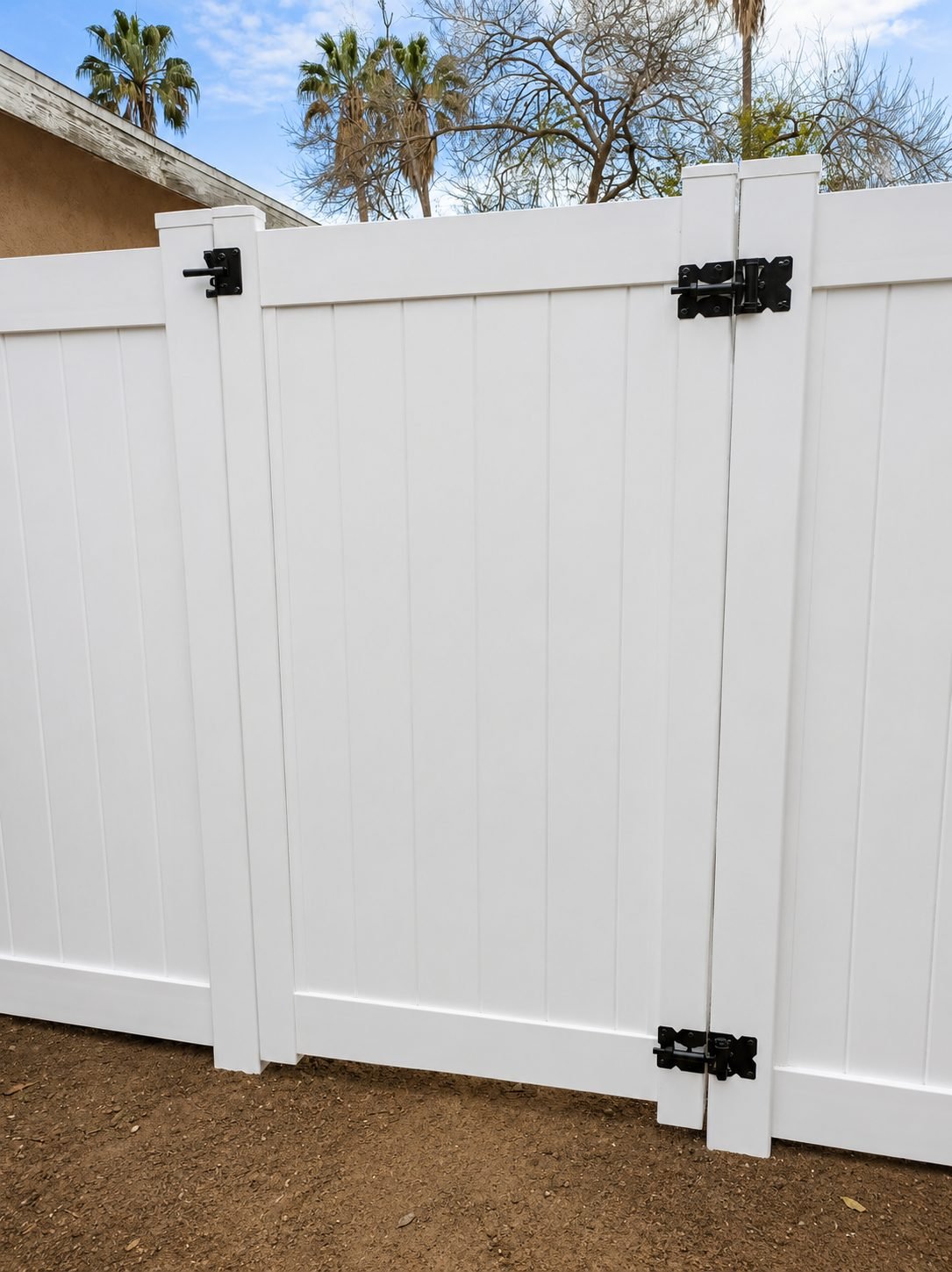
- A drive gate wide enough for vehicles and trash bins, with matte black steel hinges and latch
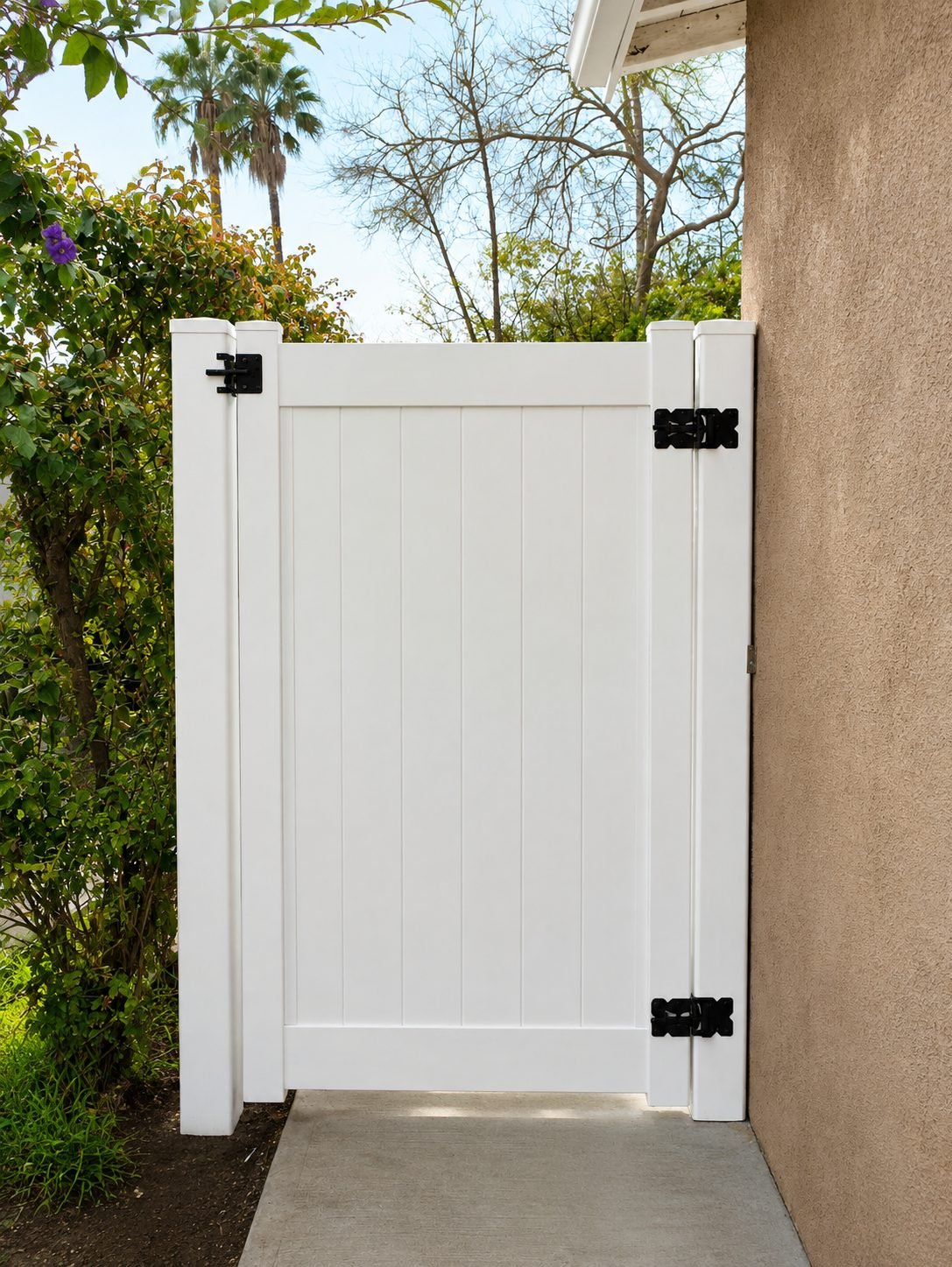
- A pedestrian walk-through gate at the side of the house with matching black hardware
- Framed panels with tongue-and-groove infill boards — no visible gaps between boards
- Flat top rail cap for a clean sightline the whole length
Why Vinyl for This Project
The owner had three requirements: full privacy, low maintenance, and a bright clean look against a warm stucco house. Vinyl was the right material for all three:
- Full privacy. Tongue-and-groove vinyl infill boards lock into each other with zero gap. From either side you get a solid white wall with no line-of-sight opening at all.
- Zero maintenance. Vinyl doesn’t need paint, stain, sealer, or annual anything. Hose it off once a year, that’s the maintenance. Wood in this same location would need re-staining every 4–6 years.
- Consistent bright white. Quality vinyl is white all the way through, not a coating on top. Scratches don’t reveal a different color underneath, and UV in Los Angeles doesn’t yellow the surface the way it does painted wood.
- Cost over the long run. Vinyl costs more up front than a basic wood fence, but the total cost of ownership over 20 years — including two full re-stains a wood fence would need — comes out ahead.
- Works against warm stucco. Bright white vinyl against a warm terracotta or beige stucco reads clean and residential. Painted wood in the same context looks harder to keep clean.
Post Work — Where Vinyl Fences Fail Most Often
The single most common failure mode on vinyl fences is the posts. Either they were set too shallow, or the concrete wasn’t a proper footing, or the posts weren’t plumbed and left to cure. Any of those and you get a wave pattern down the fence line within a year or two.
How we set posts on this job:
- Vinyl post sleeves over 4×4 pressure-treated wood inserts for extra rigidity where the gates hang — gate posts take vertical and lateral load that a hollow vinyl post alone can’t handle over the years.
- Concrete-set to 24–36 inches deep depending on soil. Poured, not dry-packed. Sloped concrete crown at the top of each footing to shed water away from the post.
- All posts plumbed with a level and braced before the concrete cures. Any post that shifts during cure gets pulled and re-set — never left crooked.
- Post spacing at panel width so no cuts or infill trims are needed at the ends — the panels sit flush between posts.
Skip any of these steps and the fence looks fine on day one and starts leaning by year three. Do all of them and the fence is dead straight at year twenty.
Panels, Rails, and How the Fence Locks Together
A vinyl privacy panel isn’t a single piece of material. It’s a top and bottom U-shaped rail, two vinyl posts that flank the panel, and vertical tongue-and-groove infill boards that slide into channels routed into the rails. On this project:
- Heavy-wall vinyl — thicker material grade than the box-store panels. Heavier feel, less flex, no visible seams.
- Full-height tongue-and-groove infill — each vertical board interlocks with the next. No visible board seams and no way for anything to slip through.
- Rails locked into the posts with routed pockets and pin fasteners — not just friction fit. This is what keeps panels from being pushed out of the rails by wind load or a shoulder pressed against the fence.
- Flat top rail cap across the full length — a clean uninterrupted horizontal line above the paneled infill. This is what makes the fence read as intentional design rather than a run of stitched-together panels.
Gates — The Part That Fails First on a Bad Install
Gates are where cheap vinyl fence installations announce themselves within the first year: sagging, rubbing the concrete, not latching cleanly. This project has two gates — a wide drive gate and a pedestrian walk-through — and both are built for the long run.
The build-quality points that matter on a gate:
- Wood-cored gate posts — pressure-treated 4×4s inside the vinyl sleeve. Vinyl alone flexes over years of gate load; wood cores keep the post rigid.
- Extra-deep concrete on gate posts — 36 inches minimum, oversized footing. The hinge post takes the entire vertical load of the gate leaf and any wind that catches it.
- Heavy-duty black steel hinges with adjustable tension — self-closing on the pedestrian gate so it never sits open on its own.
- Gravity latches that engage cleanly — no wiggle-required latch. The gate should close and lock with a single push, every time.
- Diagonal internal bracing in the gate leaf — prevents the leaf from sagging out of square over time.
- Ground clearance — the bottom of the gate sits at a consistent height above the concrete, so it never drags as the fence settles.
The black hardware against white vinyl is intentional — the contrast reads as detail rather than noise, and matte black holds up in LA sun without the fading that chrome or brass would show.
Corner Detail — Where the Fence Turns
Corners are the second place cheap fence installations show up. On a professional install, the corner post is a single unified column, panels lock in at a true 90 degrees, and the top rail turns cleanly. On a cheap install, the corner reads as two runs of fence that happen to end at the same spot.
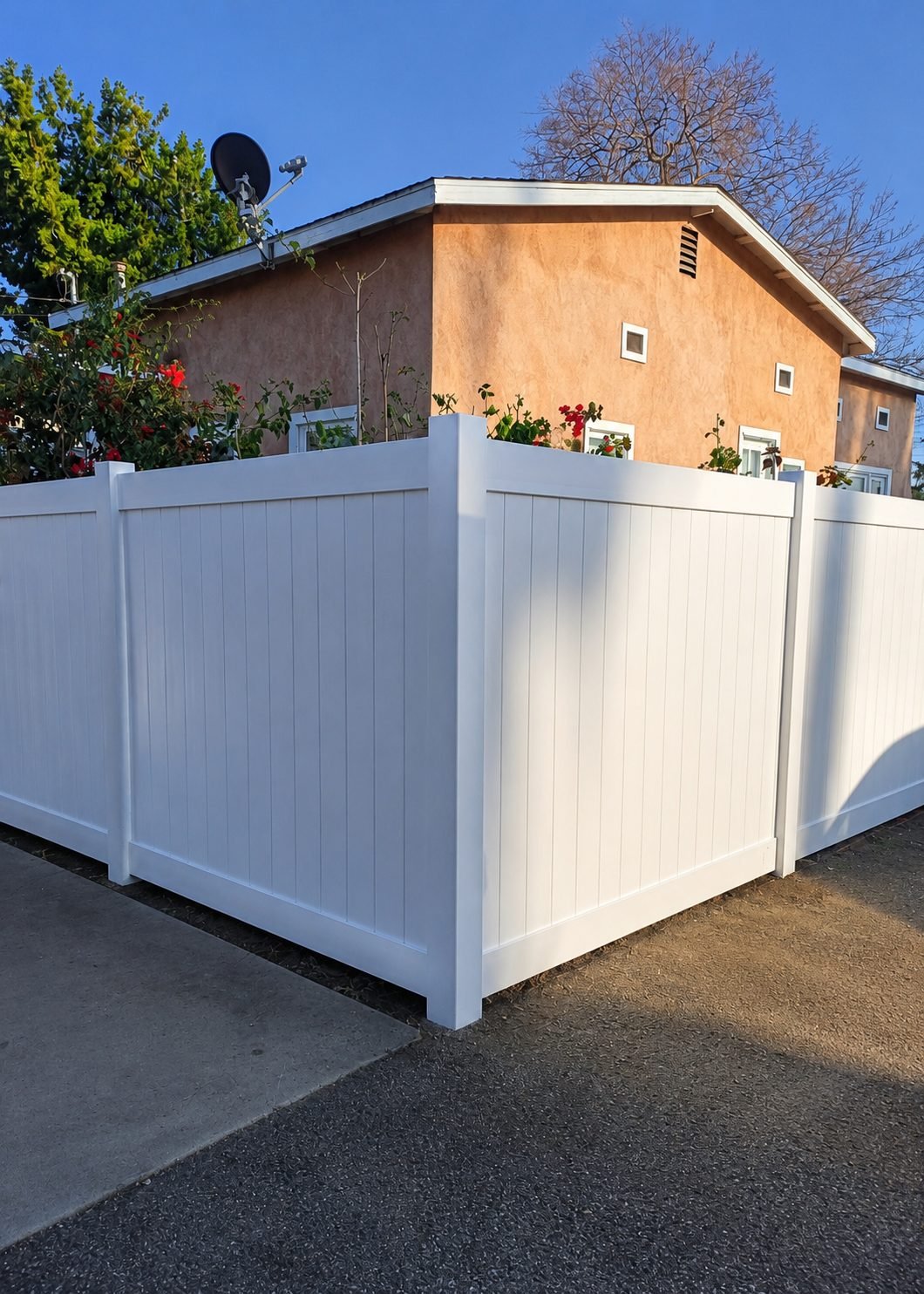
Our corner work on this fence:
- Corner posts sized to accept panel rails from both directions
- True 90-degree geometry — not “close enough”
- Top rail cap mitered at the corner so the horizontal line reads continuous around the turn
- Consistent panel height either side of the corner — no step-down
Vinyl vs Wood in Los Angeles — Real-World Tradeoffs
Homeowners often ask us to compare vinyl to a wood privacy fence. Both are valid choices; the tradeoffs are real:
- Look. Wood — even painted white — reads as wood. Vinyl reads as vinyl. Neither is “better” — they’re different aesthetics. Cedar under stain reads warmer; vinyl reads brighter and cleaner.
- Maintenance. Vinyl wins hands-down — a hose-down once a year vs a re-stain every 4–6 years on wood.
- Longevity. Vinyl 20–25 years, wood 15–20 with proper care. Both fail similarly if the posts weren’t done right.
- Upfront cost. Vinyl runs 30–50% more than a comparable wood privacy fence, install-and-materials.
- Repair. Wood is easier to spot-fix — swap a bad board. Vinyl needs matching panels or infill boards from the manufacturer.
- Sun and weather. Quality vinyl doesn’t yellow, warp, or split in LA sun. Cheap vinyl does — this is why product grade matters more than material choice.
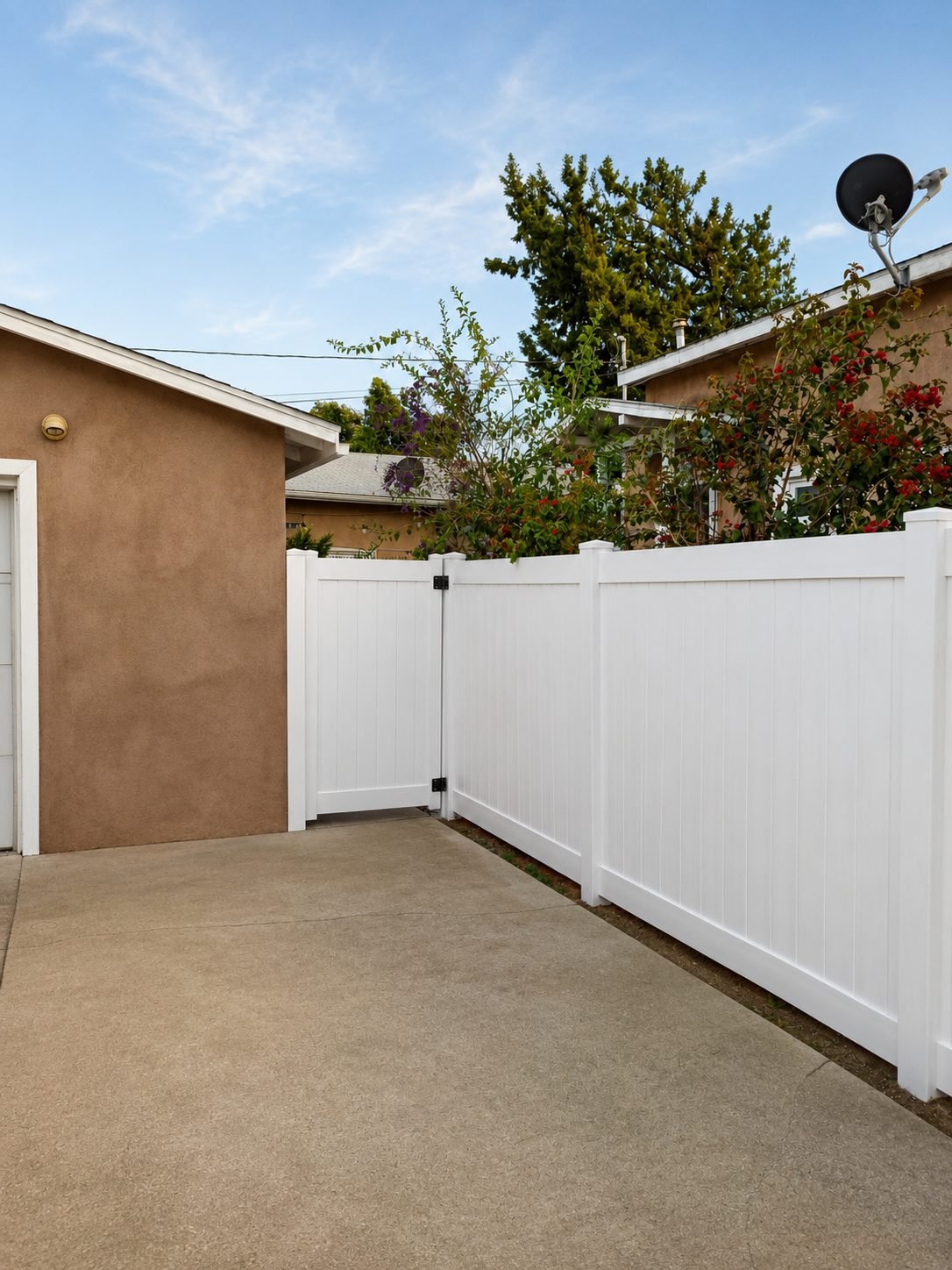
How This Fence Holds Up in Los Angeles Conditions
With quality vinyl, correctly set posts, and hardware built for the load, this fence will look the same in five, ten, and fifteen years as it does the day it was installed. The specific conditions vinyl handles well in Los Angeles:
- UV exposure. Quality vinyl has UV stabilizers built into the material. It doesn’t yellow, chalk, or fade.
- Heat cycles. Vinyl expands and contracts less than wood over daily temperature swings — the panel-in-rail construction absorbs any movement without stressing the joints.
- Occasional heavy rain. Vinyl doesn’t absorb water. No rot at the ground line, no swelling, no black moisture stains on the wood grain.
- Sprinkler over-spray. Same story — water beads off, no staining, no damage.
- Salt air. Coastal LA houses get salt exposure that eats galvanized hardware over time. Matte black powder-coated steel handles it better than raw galvanized, and the vinyl itself is unaffected.
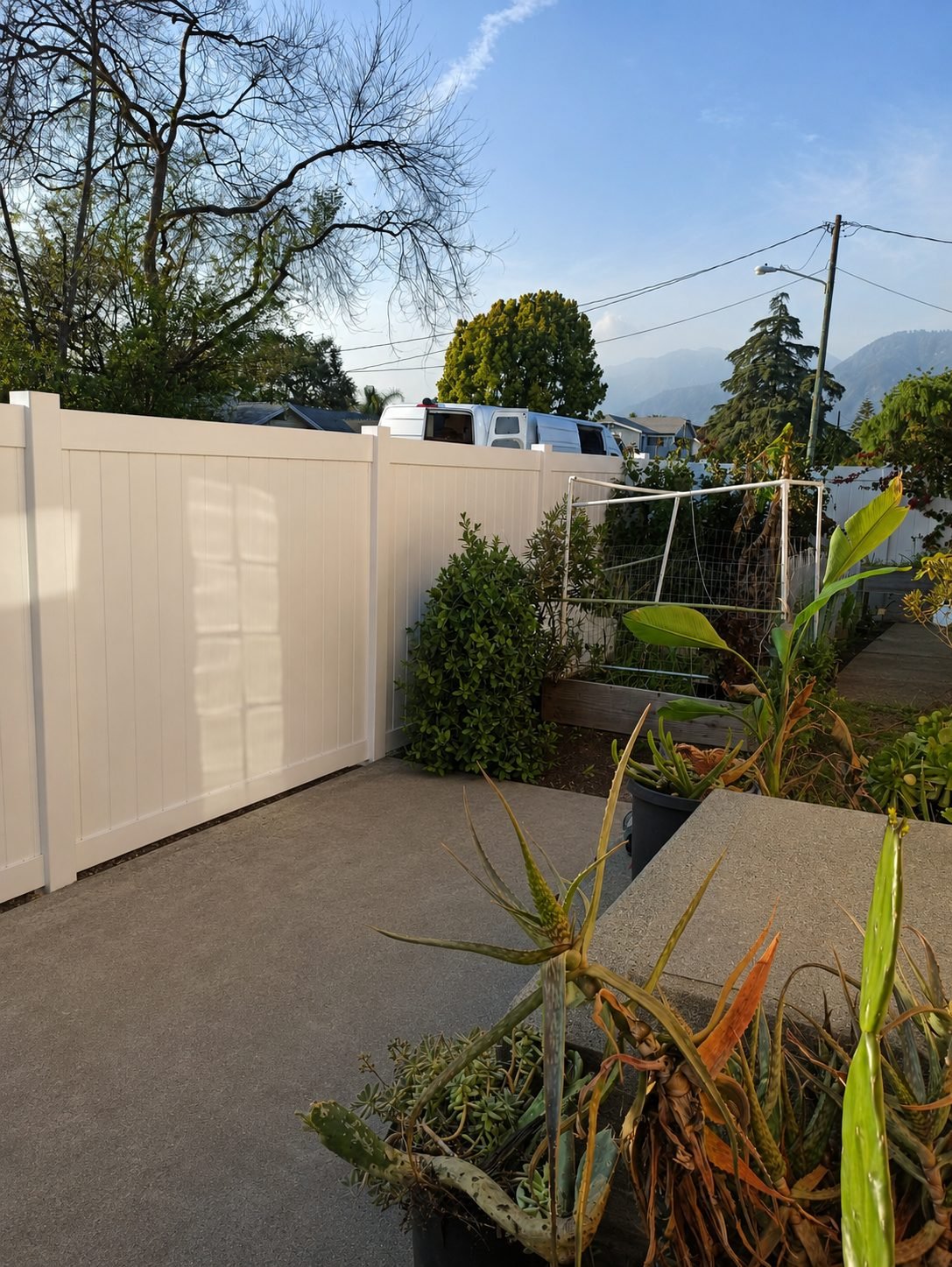
What Separates a Professional Vinyl Install from a Weekend Job
Vinyl is one of the more common fence types homeowners try to install themselves. The material seems friendly — it comes in kits, the parts look self-explanatory, and there are no boards to cut or stain to apply. So why doesn’t every DIY vinyl fence last?
- Post depth and concrete footings — DIY jobs typically go too shallow or skip the concrete crown.
- Posts not plumbed during cure — the fence takes on a lean before the concrete sets.
- Panel-to-post fit — DIY installers force panels that don’t quite fit rather than cutting posts to correct spacing.
- Gate posts without wood cores — vinyl-only gate posts sag within a year.
- Cheap hardware — big-box gate hinges are the first thing to fail.
- Missing internal gate bracing — the leaf goes out of square in the first winter.
A professional install fixes all of these before they become problems. That’s most of what you’re paying for.
Considering a Vinyl Privacy Fence in Los Angeles?
ProHands Home Improvement designs and installs white vinyl privacy fences, custom vinyl gates, and mixed-material fence runs across Los Angeles, Glendale, Burbank, Pasadena and the surrounding neighborhoods. Full-perimeter privacy, side-yard runs, driveway fences with matching gates — every install sized to the property and built to last two decades without a repair call.
Contact us for a walk-through and a straight-forward quote — real product spec, real footing depth, real gate hardware.