
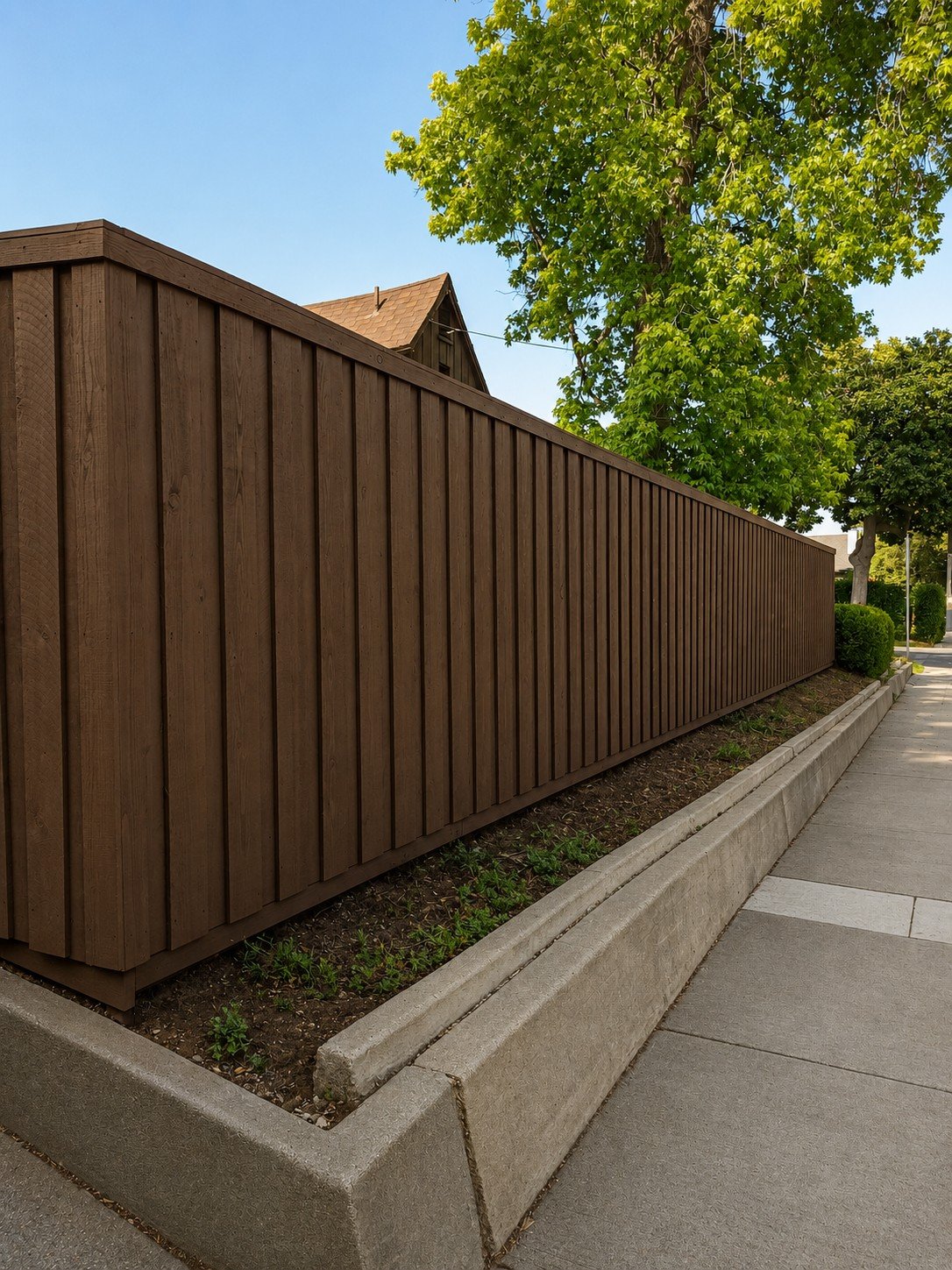
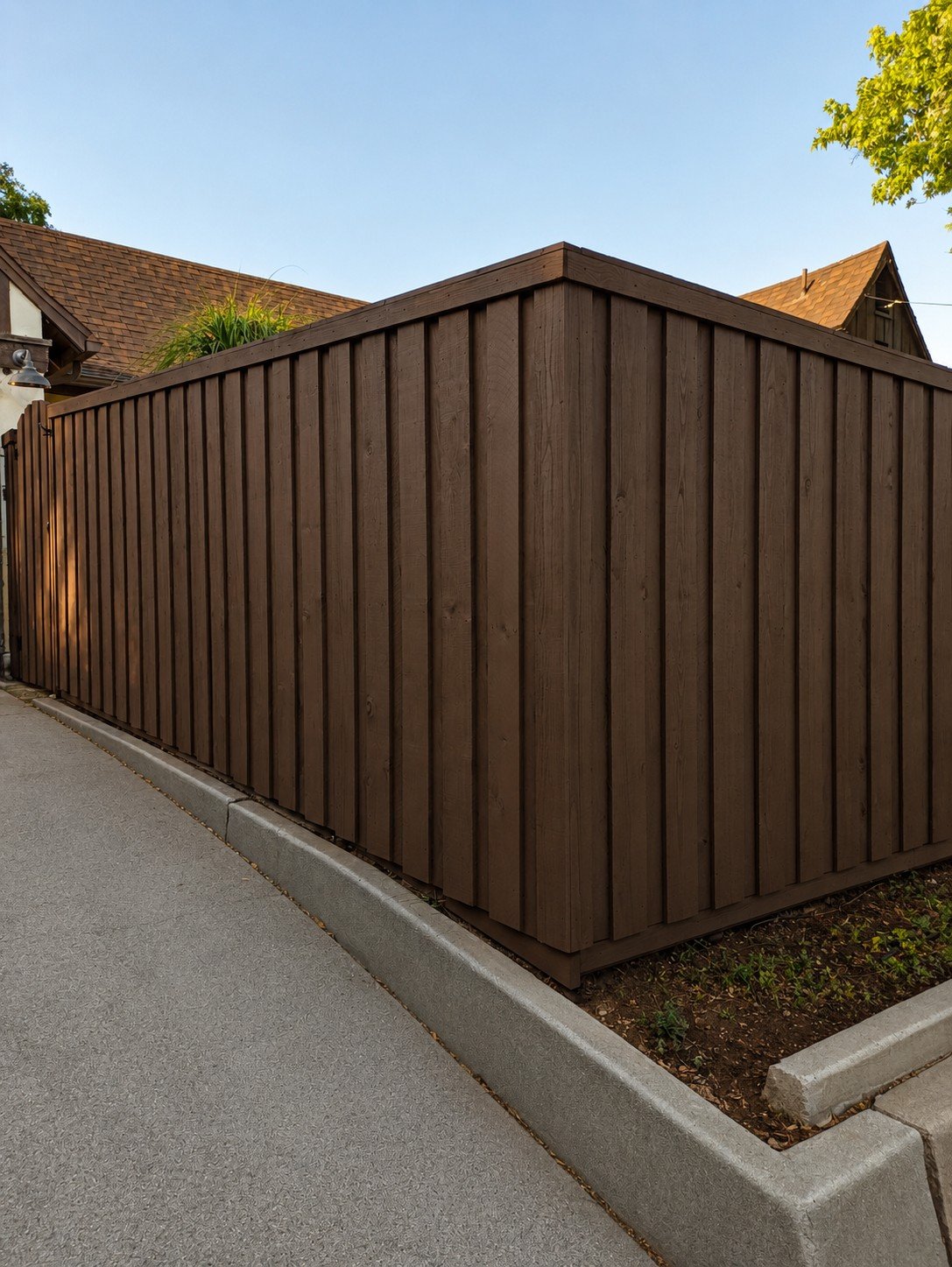
A custom board-and-batten wood fence around a Tudor Revival home in Los Angeles, stained in a deep espresso brown that matches the trim carpentry on the house itself. Full-perimeter run: sidewalk face along the front, driveway return down one side, pedestrian gate and vehicle gate integrated into the same visual language, back-yard side with framed panels and a mid rail. Every panel, every gate, every cap piece assembled and finished on site — no stock panels, no shortcuts.
The design brief was specific: the fence had to belong to the house. Tudor Revival architectura carries a specific visual weight — steeply pitched roofs, half-timbered gables, warm brown stains on structural woodwork — and a light natural-wood fence would have argued with all of it. The answer here was a fully-clad, dark-stained board-and-batten with a strong cap and grounded kickboard, so the fence reads as an extension of the house rather than an add-on around it.
Project Overview
Scope on this Los Angeles Tudor Revival fence build:
- Custom board-and-batten wood fence around the full residential lot, ~6 feet in overall height
- Vertical field boards with narrow batten reveals joining every seam
- Deep espresso / dark chocolate stain finish, applied on-site after installation
- Continuous top cap and full kickboard at grade on every run
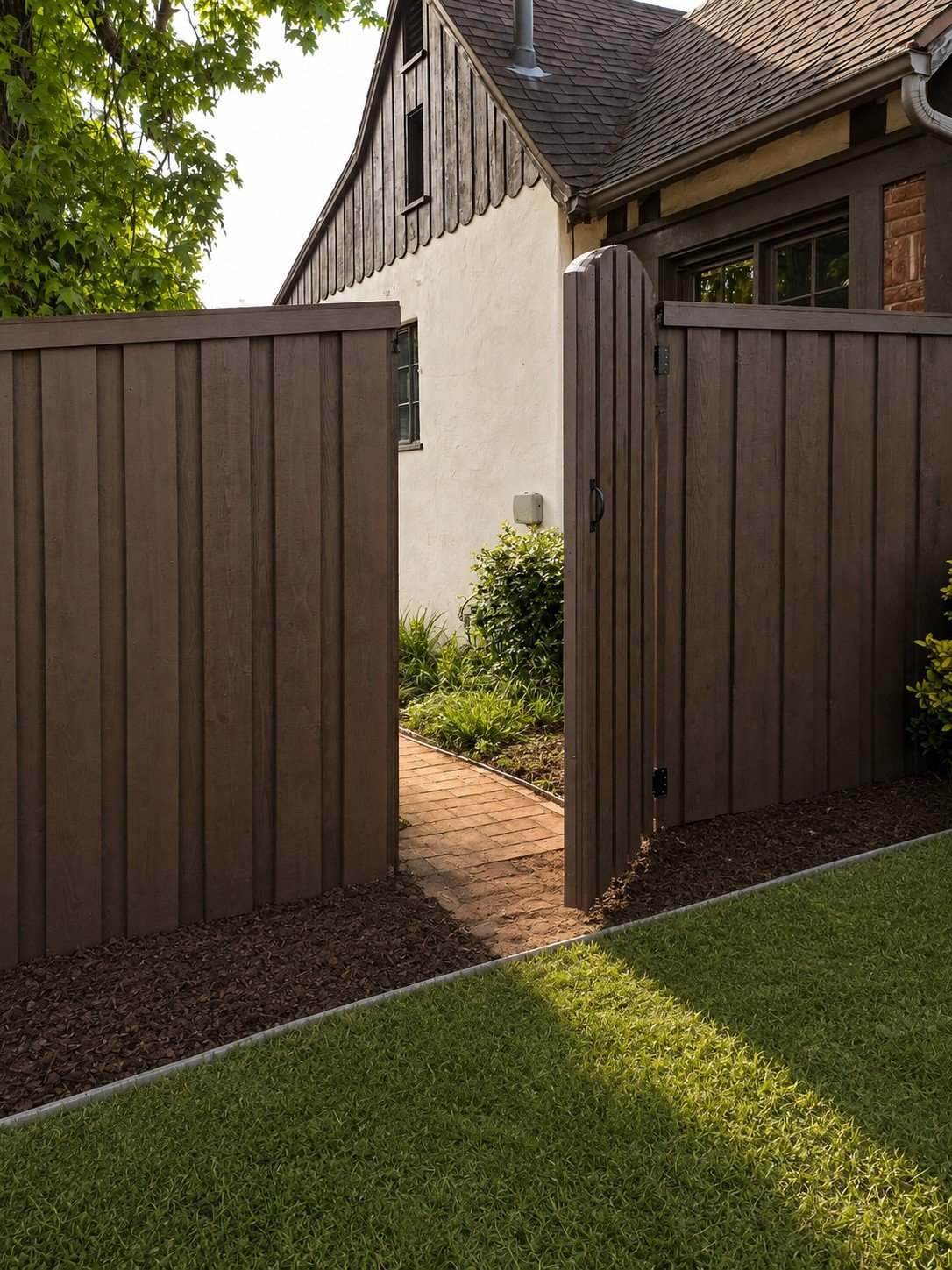
- Two custom arched gates — pedestrian entry to the front courtyard, and a wider drive gate
- Integration with an existing poured-concrete retaining wall / raised planter along the sidewalk
- Heavy black powder-coated hardware — hinges, cane bolts, pull handles — matched across every gate
Why Board-and-Batten for a Tudor Revival Home
Board-and-batten is one of the oldest wood-siding vocabularies in American residential construction. It works on a fence for the same reasons it works on a house — it reads as substantial, purposeful, and quiet in its detailing. On a Tudor Revival specifically, board-and-batten is close to native language:
- Vertical rhythm matches the architecture. Tudor Revival gables and half-timbering emphasize vertical lines. A vertical board-and-batten fence carries that rhythm around the property instead of introducing a competing horizontal pattern.
- Board-plus-batten reads as intentional joinery. A plain vertical picket fence looks like a fence. A board-and-batten wall looks like a considered wood surface — the batten strip explicitly covers each seam and adds a shadow line every eighteen or twenty inches down the face.
- Dark stain matches the house’s material language. Tudor Revival stucco pairs with dark wood trim by tradition. A dark-stained fence sits inside that tradition instead of trying to invent a new one. Natural cedar would have read as too light and modern; painted white would have read as suburban.
- The scale absorbs the size of the property. On a smaller yard a natural picket fence works. On a full lot with a substantial house behind it, board-and-batten holds visual weight so the fence doesn’t disappear into the architecture and doesn’t look thin against it.
The Espresso Stain — On-Site, After the Fence Is Built
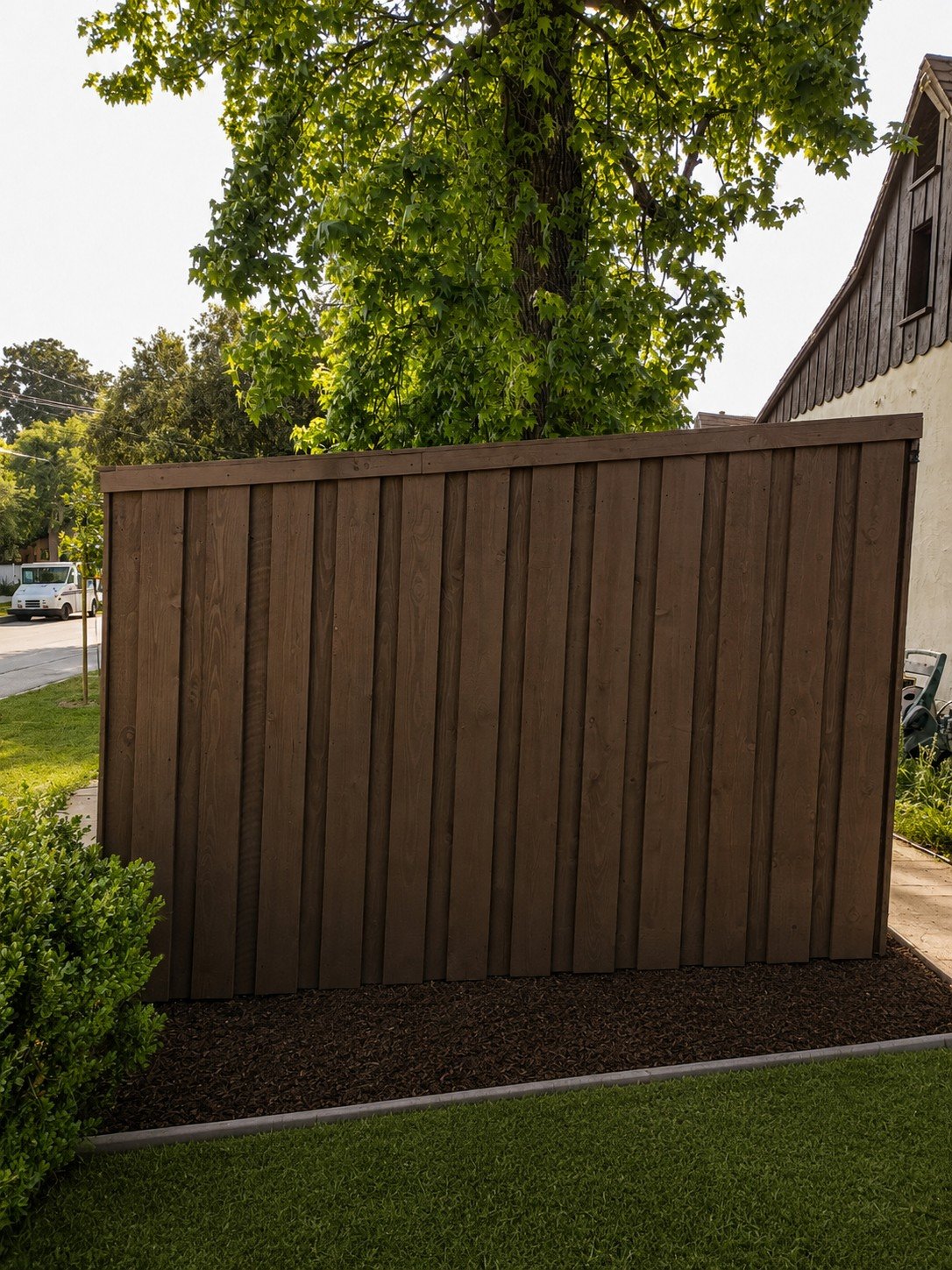
The chocolate/espresso stain on this fence is a semi-transparent penetrating finish, brushed on after the fence was fully assembled. Two coats, front and back and the top edges. The specific process matters:
- Applied after installation, not before. Pre-stained boards look uniform in the truck; installed together they show every raw cut end and every untreated fastener path. Staining after installation covers every exposed grain surface — the cut ends at the top cap, the notches around the mid rail, the back side of the batten strips.
- Penetrating stain, not surface paint. A film-forming paint on a wood fence peels within three to five years — the film cracks along the grain, water gets under, and the whole thing needs to be scraped and repainted. Penetrating stain goes into the wood fiber, ages by fading rather than by peeling, and can be re-coated without any surface prep beyond a rinse.
- Semi-transparent, not opaque. The stain is heavy enough to give the fence its dark tone, but light enough that the actual wood grain shows through at close range. On a house with real material honesty in the architecture — hand-shingled roofs, exposed rafter tails, half-timbering — that grain visibility matters.
- End-grain sealer at the tops of every board. Before the top cap went on, every board end got a dedicated end-grain sealer coat. End grain absorbs water at roughly ten times the rate of face grain — every failed wood fence in this climate fails first at the top. Sealing that end grain before capping is a thirty-year decision.
Custom Arched Gates — The Signature Detail
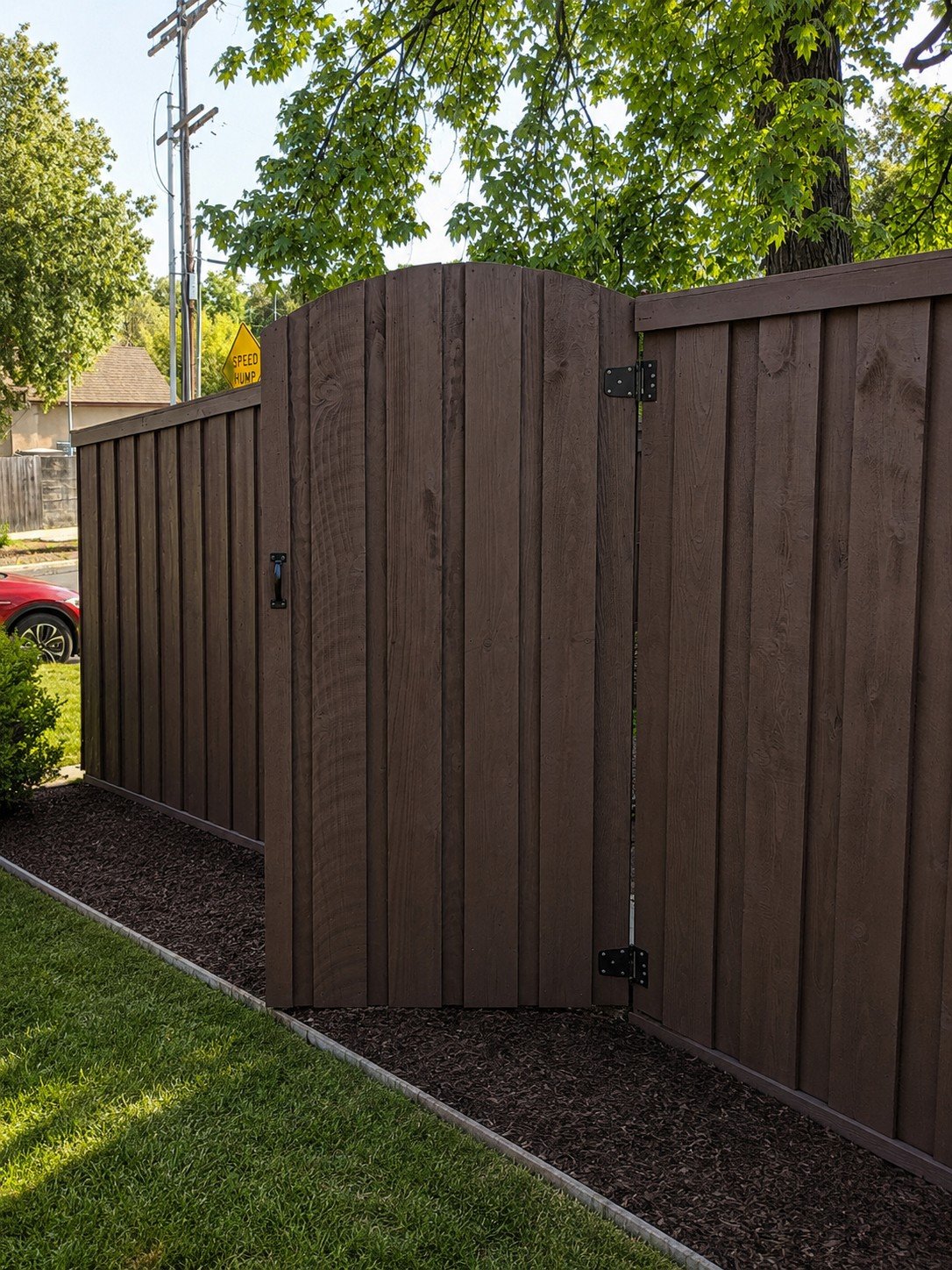
The pedestrian gate and the drive gate both carry a hand-cut arched top — not a stock gate insert, not a router-templated curve, but an arch scribed and cut on site to match the rise of the actual gate opening. The arch does something important that a flat gate can’t: it borrows a visual cue from Tudor Revival stone-arched doorways and translates it into a fence gate.
What’s in each gate:
- Full board-and-batten face on both sides. The gate matches the fence in material, tone and rhythm — no thin-panel gate face with a heavy frame showing on the back. Both sides are finished the same way.
- Steel frame core inside the gate. A pedestrian gate this size in solid wood weighs enough to sag on the hinge side within a year if it’s just wood-to-wood. The steel frame inside carries the load; the wood cladding does the visual work.
- Heavy black powder-coated hardware. Barn-style hinges, black cane bolt, matching pull handle. The hardware is sized for the gate — a lightweight hinge on a heavy solid-wood gate is the single most common failure mode in residential fence work.
- Ground clearance detailed for the site. The gate closes above a specific ground-line elevation — enough clearance for the concrete pad below to expand under summer heat without binding the gate, tight enough that it doesn’t read as a gap.
Integration With the Existing Retaining Wall
The front sidewalk elevation on this property runs about eighteen inches below the yard grade, held back by an existing poured-concrete retaining wall and a raised planter. The fence had to sit on top of that wall without pulling the wall apart or losing its own structural line.
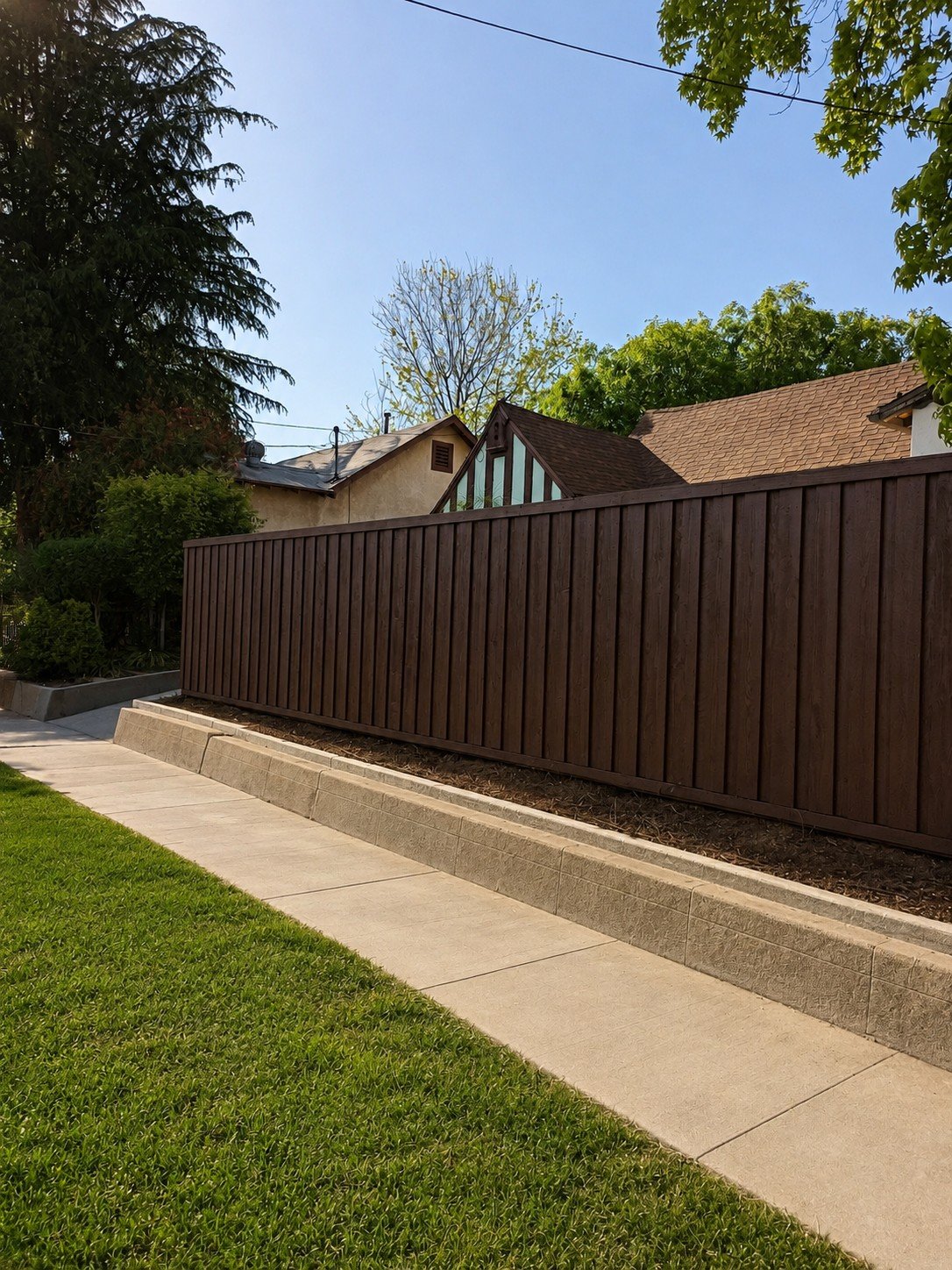
- Sill plate anchored into the wall top. A pressure-treated 2×6 sill plate runs the length of the retaining wall, anchored with epoxy-set stainless anchors. This becomes the flat platform every fence post lands on.
- Post feet, not through-post penetrations. The wall top isn’t drilled through with post cavities. Instead, each post lands on a steel post foot bolted through the sill plate — the load transfers into the sill and out along the wall top instead of concentrating at any single point of the concrete.
- Flashing under the sill. A galvanized flashing detail runs between the sill and the wall top. Water that finds the sill exits over the front face of the wall instead of soaking into the joint and freezing the cycle.
- Kickboard clears the planter dirt line. The bottom of the fence stays above the planter’s soil line by an inch and a half, so drip irrigation and mulch don’t wick moisture into the fence bottom.
Under the Finish — What Makes a Board-and-Batten Fence Last
A board-and-batten fence looks fifty years old on day one — it should look the same at year twenty. That happens when the substructure is built for it:
- Cedar boards, cedar battens. Both the field boards and the narrow batten strips are western red cedar — matched species, matched grain behavior. Mixing pine battens over cedar boards is a common cost-saving shortcut that leaves visible movement lines within two summers.
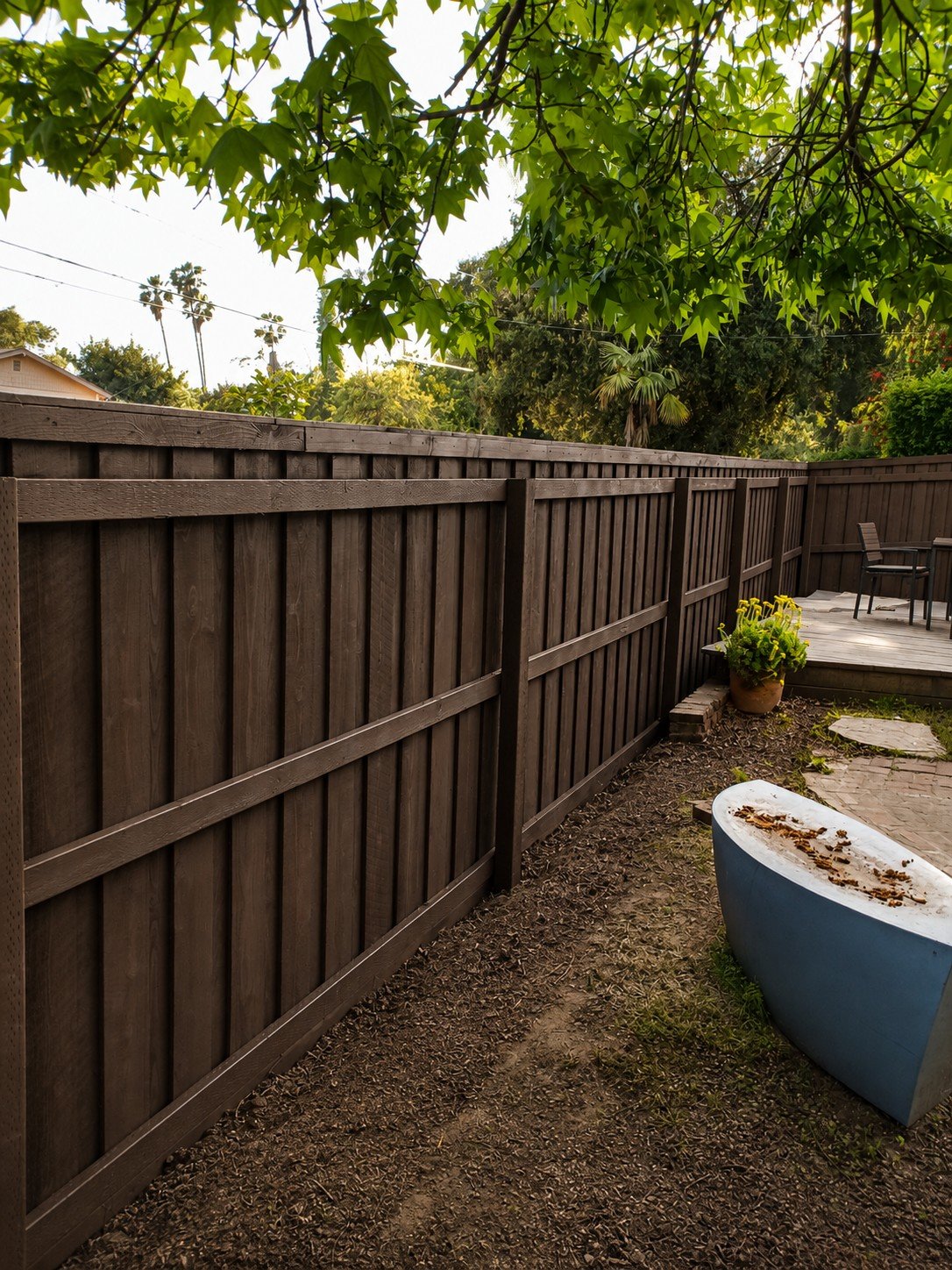
- Pressure-treated posts. Posts are pressure-treated for ground contact and disappear under the same espresso stain as the wood cladding. The stain unifies the color; the pressure treatment carries the twenty-year timeline where cedar posts alone can’t.
- Post depth to code and beyond. Two feet of concrete around every post, which is one-third of the fence height. On the retaining-wall run the sill plate replaces this — but on every dirt-mounted post, the ratio holds.
- Framed panels with a mid rail. On the taller back-yard sections a horizontal mid rail runs between the posts, so the vertical boards get support at the middle of their span. Without a mid rail the boards cup outward over time and the batten reveals lose their crisp line.
- Structural screws at every connection. Cap-to-post, sill-to-wall, rail-to-post — every structural connection is a galvanized structural screw, not a nail. Wind load on a solid fence is real, and structural screws are what carry it.
- Ring-shank nails on the batten strips. The battens themselves are fastened with galvanized ring-shank finish nails at consistent intervals. Ring shanks grip through seasonal humidity swings; smooth nails let the batten strips walk away from the boards.
How This Fence Ages
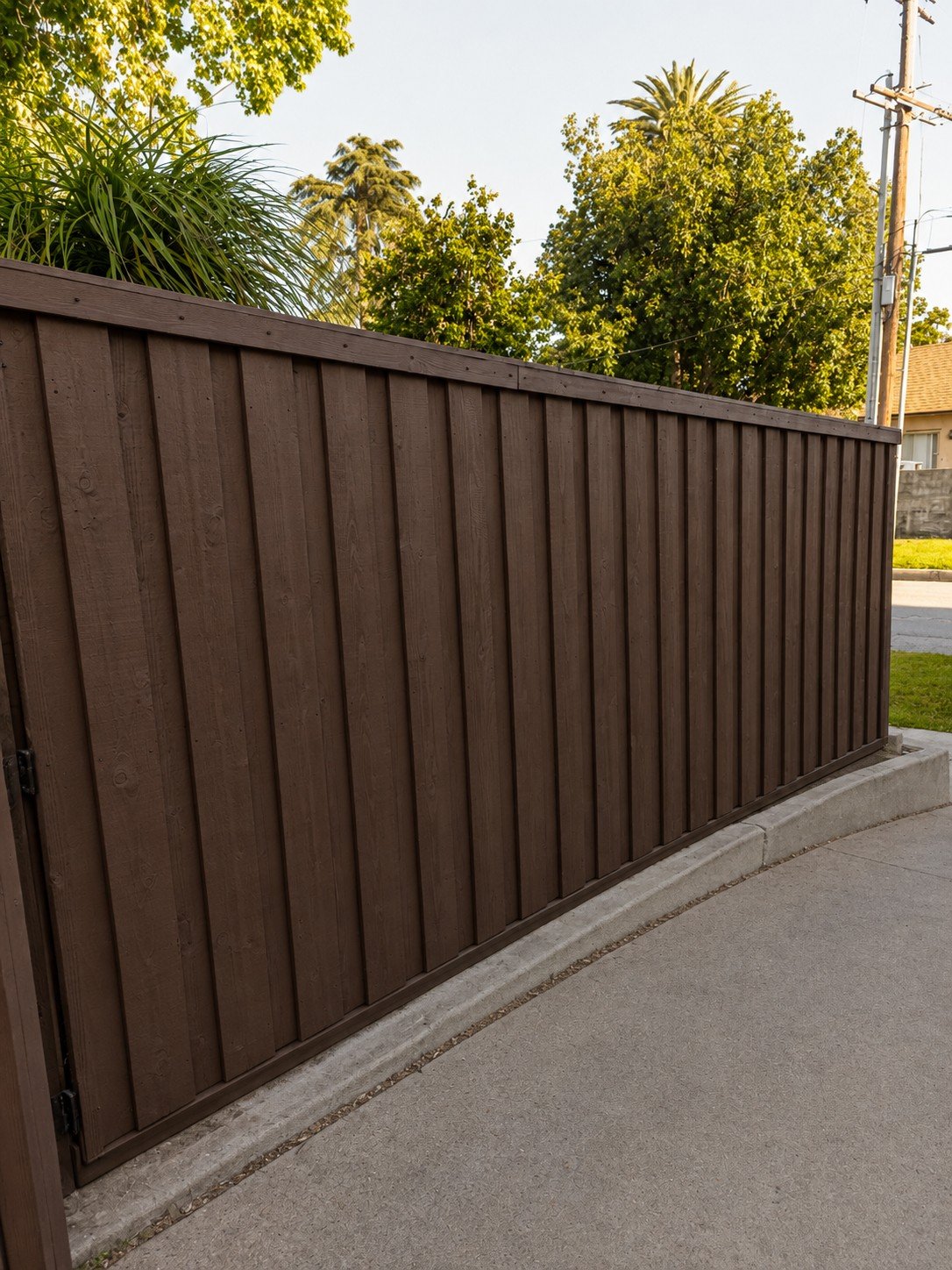
An espresso-stained board-and-batten cedar fence in Los Angeles, built to this specification:
- Year one. Uniform deep chocolate tone throughout, cap sharp, hardware black and crisp. No maintenance required.
- Years two to four. The stain begins to fade slightly on the sun-facing runs — most visible on the street face, less visible on the shaded back yard. Total color shift is small and even; the fence still reads as a fully-stained fence rather than as a fading one.
- Year five. Recommended recoat window. A single semi-transparent penetrating stain pass, applied by brush after a light wash, refreshes the entire fence in one day per side. The stain buys another five to seven years before it needs attention again.
- Years five through fifteen. Stable. Recoat cycle repeats every five to seven years depending on sun exposure. Substructure is untouched — cedar cladding, cedar battens, pressure-treated posts, structural fasteners are all still in service.
- Year twenty and beyond. The stain finish keeps refreshing on schedule. Individual board replacement is possible on any panel that catches damage — the rest of the fence is untouched.
When a Custom Stained Board-and-Batten Fence Is the Right Answer
- Your home is Tudor Revival, Craftsman, English cottage, Storybook — architecture with real material weight where a light natural-wood fence would fight the house
- You want a fence that reads as part of the property, not as a boundary marker around it
- You want dark, warm exterior wood — not white vinyl, not natural cedar silver
- You value proper stained-fence maintenance (a light refresh every five to seven years) over painted-fence maintenance (a scrape-and-repaint cycle every three to five)
- You need custom gate work integrated into the fence — arched tops, matched hardware, properly-framed and finished on both sides
Planning a Custom Stained Board-and-Batten Fence in Los Angeles?
ProHands Home Improvement designs and installs custom board-and-batten fences, cedar and redwood privacy fences, custom stained wood gates, and full exterior woodwork packages across Los Angeles, Glendale, Burbank, Pasadena and the neighborhoods around them. Every fence stained on site after assembly, penetrating stain over end-grain sealed board tops, pressure-treated posts under color, structural fasteners at every connection, custom gates built to match. The specific choices that separate a fence that belongs to the house from a fence that stands next to it.
Contact us for a walk-through and a straight-forward quote — real material grade, real installation method, real long-term result.