
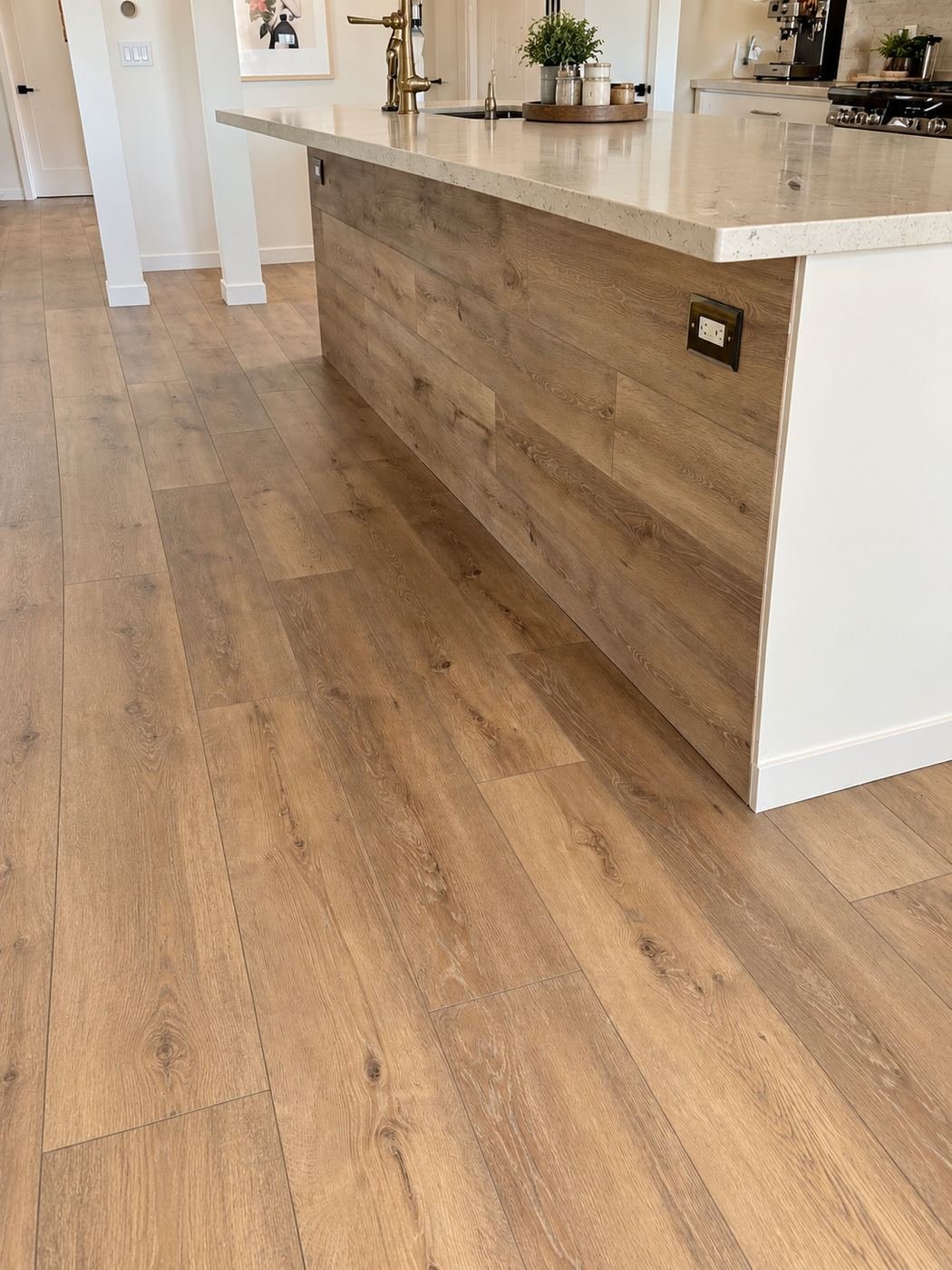
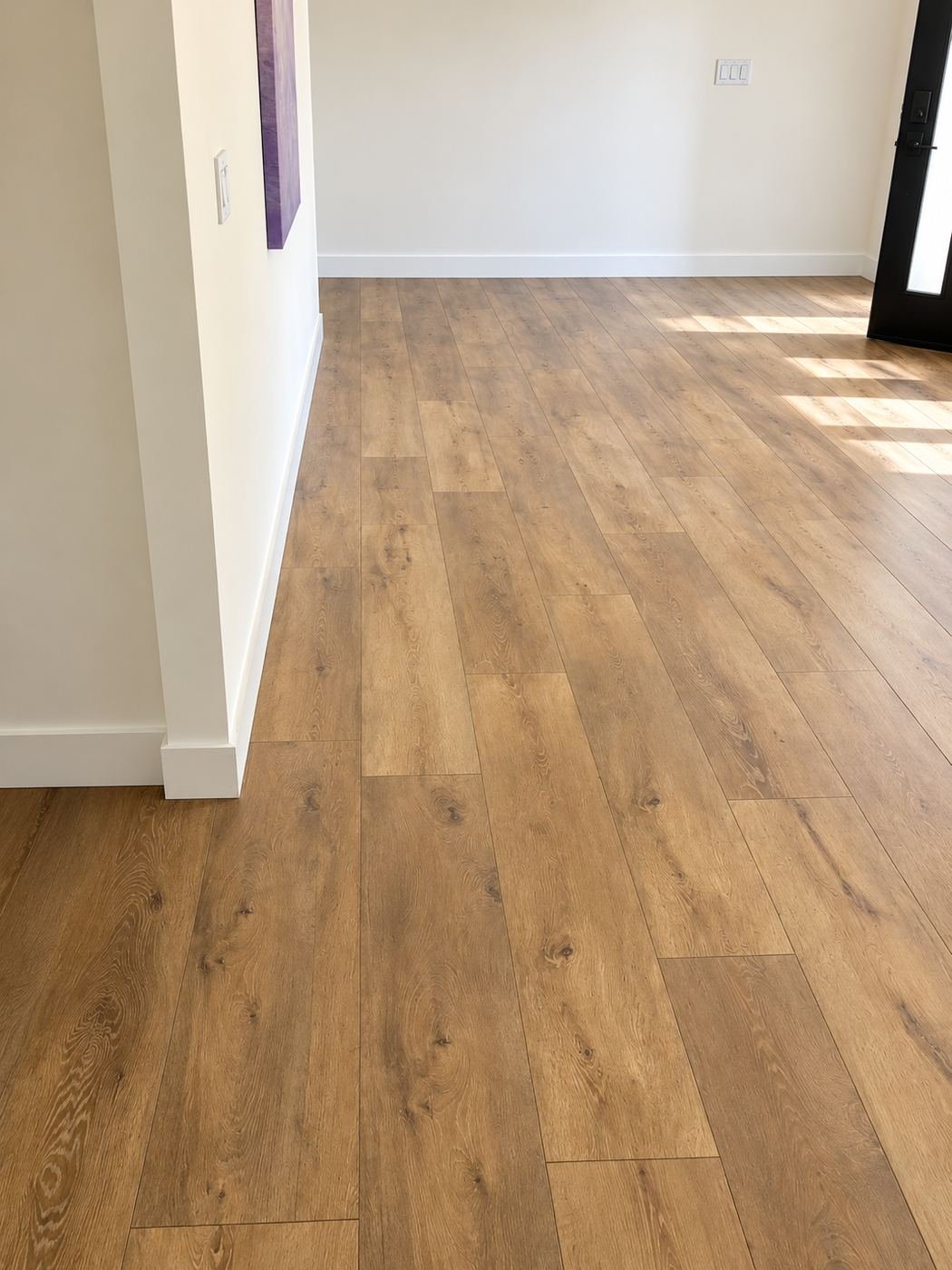
A full flooring reset for a Los Angeles home — about 2,800 square feet of wide-plank warm-oak LVP laid as one continuous field across two living rooms, the kitchen, a long central hallway, the laundry and a bedroom. No T-moulding transitions in doorways; the same plank runs straight through every opening. The job started with the demolition of a previous install from another contractor that had buckled — the planks had peaked into visible ridges along the seams, which is the classic signature of a floor that was not installed with the right expansion gaps or the right prep underneath.
Why the previous floor failed
Floating floors — LVP, laminate, engineered — are not glued down. They are designed to expand and contract with temperature and humidity, and they do that as one connected sheet. If any of three things is wrong at install, the sheet has nowhere to move and the planks push up against each other and peak into ridges that read as a herringbone across the floor:
- No expansion gap at the walls, under baseboards, around jambs, and around cabinets. The industry number for most products is 3/8″ minimum. Install straight to the baseboard and you have built in failure.
- Kitchen island or heavy cabinets sitting on top of the floating floor, pinning it so it cannot move. The field has to run around them, not under them.
- Subfloor not flat or not dry. Most products allow 3/16″ over 10 ft. Beyond that the planks flex at the clicks and the joints eventually open and snag.
On this house we tore the existing floor out, confirmed the subfloor was level and dry (it was), and started fresh with the planks the client had already purchased.
What one continuous 2,800 sq ft field actually requires
- Underlayment seams aligned, not offset the way they shipped. Taped at every seam so moisture does not creep up and the field reads as one layer.
- A single reference line snapped across the longest run — not room by room. Every plank in the house gets rotated off that one line. That is why nothing drifts off-angle at a doorway.
- Expansion gaps everywhere: walls, jambs, slider tracks, around the island, around the fireplace hearth, around the laundry closet threshold.
- No fixed cabinetry or island pinning the field. Where the client wanted the island to look wood-wrapped on the base, we clad it in matching planks separately so the island reads like it is sitting in the floor without actually trapping it.
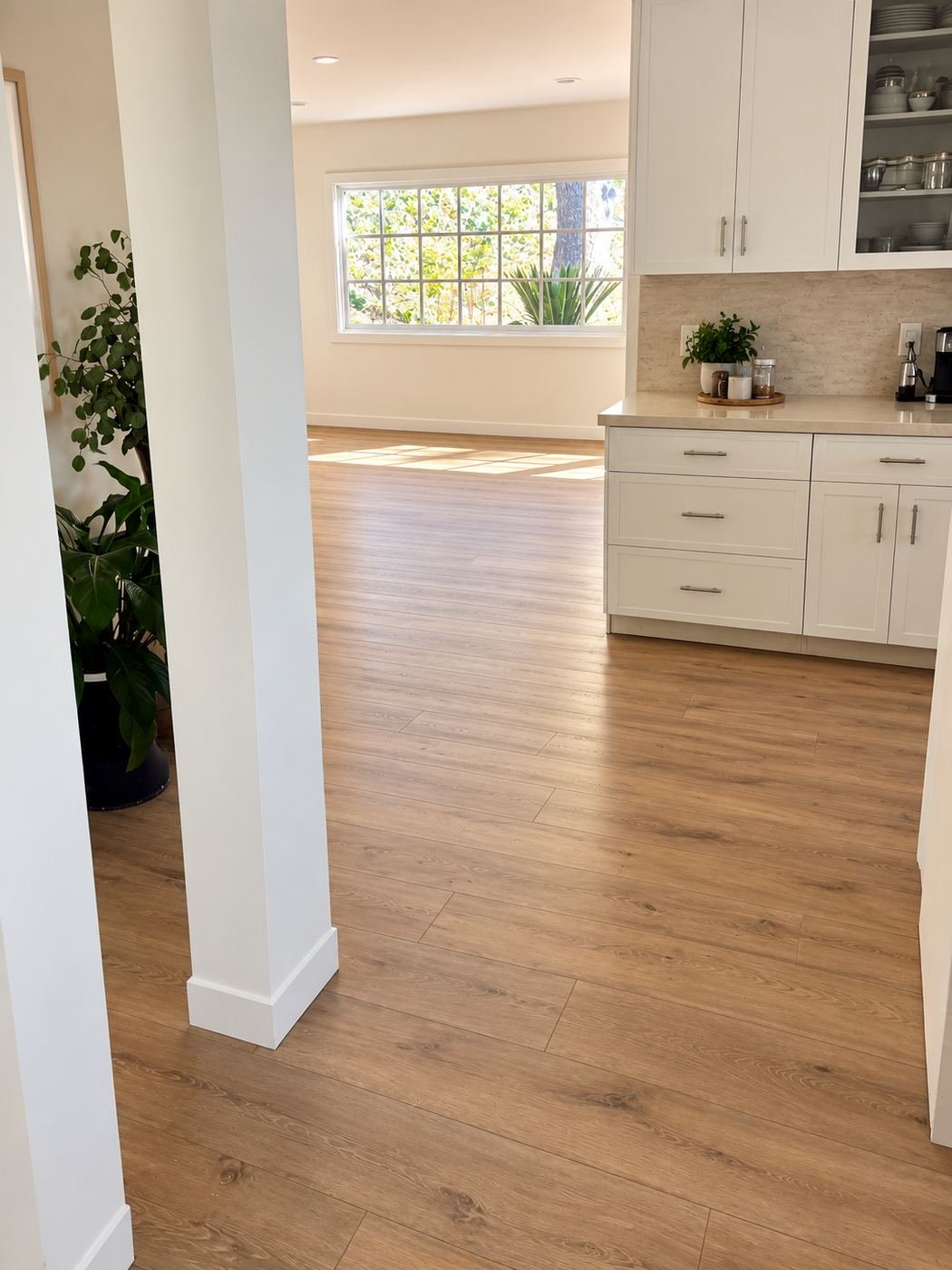
- Door jambs under-cut so planks slide neatly under the moulding instead of butting against it — one of the small details that separates a continuous install from a quilt of rooms.
What the finished floor looks like
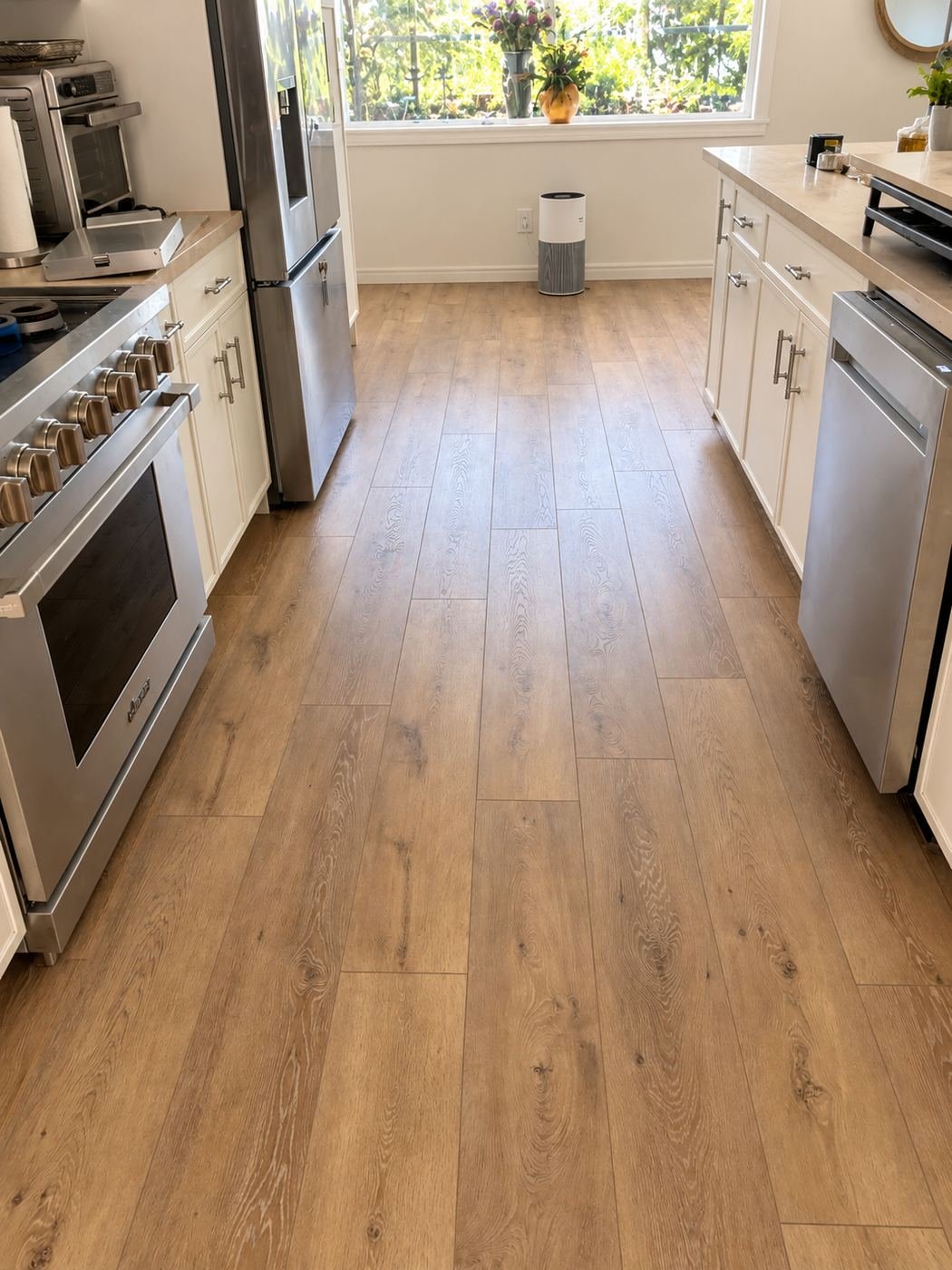
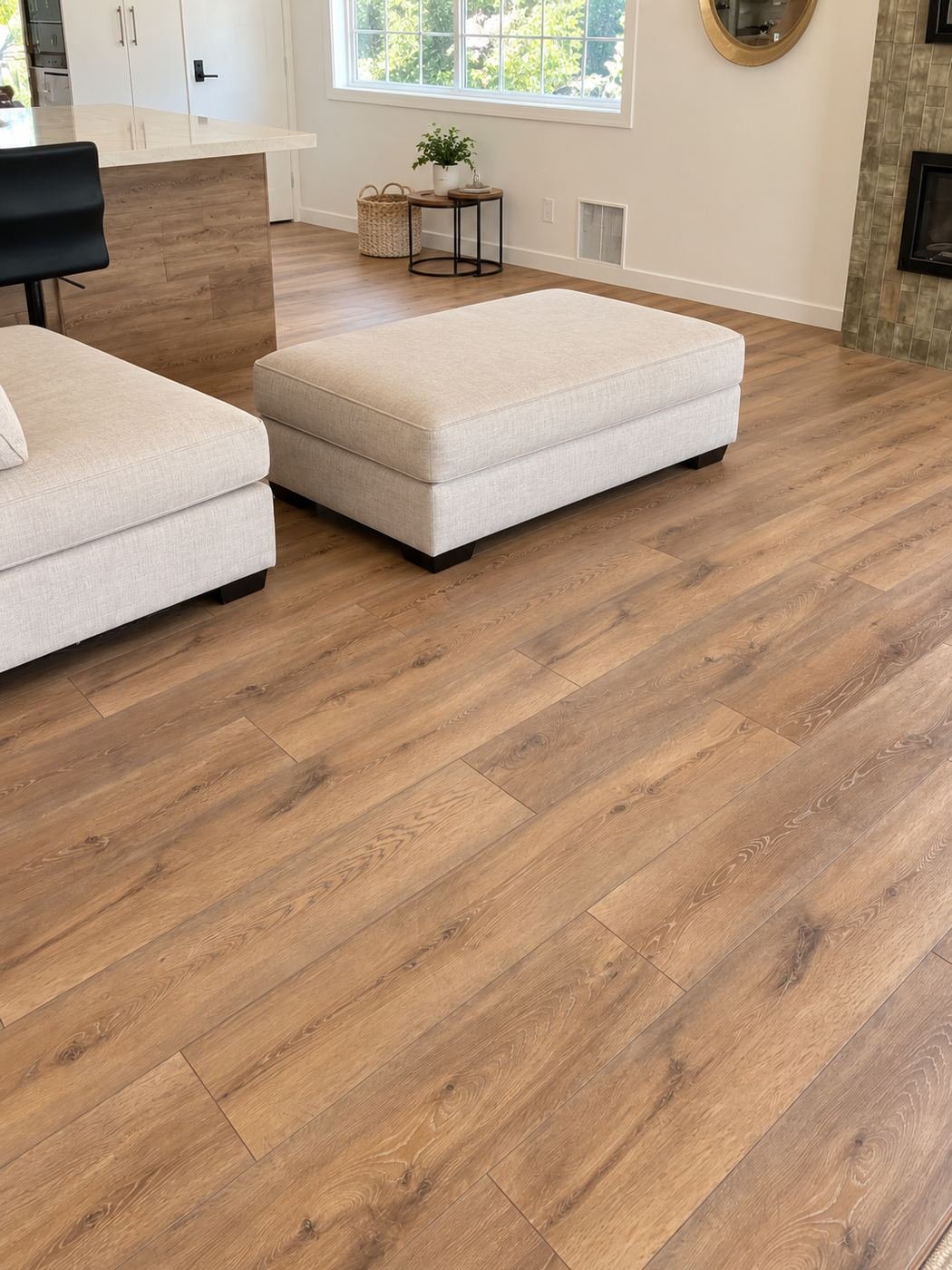
Living room one flows into living room two, into the kitchen, into the hallway, into the laundry and into the bedroom — same plank, same seam direction, no T-moulding, no thresholds. From the entry door you can look all the way to the back of the house and the eye follows one surface. The warm oak tone softens the white cabinets, the quartz counters and the stainless appliances; the plank width (around 7-9″) is right for the volume of these rooms.
What to check before you let someone install a floating floor in your house
- Ask about expansion gaps — not just at the walls but at jambs, cabinets, hearth, slider tracks. If the answer is vague, the floor will peak within a season.
- Ask whether cabinets will sit on the floating floor. If yes, the field will pin eventually. Correct answer is cabinets first, floor around them — or clad the base separately.
- Ask about subfloor flatness and moisture testing on concrete slabs. “We’ll just lay it” is not an answer.
- Ask whether rooms will be run as one field or room-by-room with T-mouldings. One field is harder to install and significantly nicer to live with — it is a reasonable thing to pay for.
Have an LVP, laminate or engineered floor that has started peaking, lifting at seams or going hollow — or planning a new install and want it done right the first time? Call ProHands at (818) 401-7766 or email info@prohandshandyman.com for a free on-site walkthrough. Greater Los Angeles.